“I’m feeling very tired. I sense that things are approaching the pointy end,” David whispers, as he lies on the daybed, set out on his shaded Darwin verandah, next to that quite rare, tropically-adapted cherry tree. We talk quietly for about 20 minutes, Uta in the kitchen, sensitively absent as we relive shared adventures, reflections now being squeezed into precious minutes.
He dozes, I leave, promising Uta that I will return tomorrow, an acknowledgement that time is limited, visits necessarily short, hopefully many more still to come.
Back in my hotel, lips tremble as the memories of those shared times swirl. It has only been eight years since we met. He and his partner sought advice about setting up a tourism venture on their traditional estates, Barabba country, south of Maningrida, east of Darwin. Since that first meeting, we’ve shared so much.
We walk extensively through the country. “I have the OK to bring small numbers of visitors here. But I have assured the senior mob that I will clear a suggested itinerary with them before we start. They instruct me to avoid several secret, sacred places; mortuary sites, that special mountain to the south of the camp.”
The tall rock outliers, many jutting directly out of the river’s wet season floodplains, house thousands of rock art galleries. “See that animal up there? A bit rhino-looking: it’s a diprotodon, died out tens of thousands of years ago, yet we used to hunt them. And that one, the one with the stripes, it’s a thylacine!”
Hand stencils, kangaroos, fish, snakes, crocodiles, and finely drawn, red-ochred human figures look out from the galleries. We walk and talk for days.
The small group safaris commence and quickly find an appreciative and lucrative audience. In particular, travellers from Europe and North America are making up a sizable proportion of the numbers. “We need to go into market and tell the travel trade about my tour.” Over the next five years, he and I engage with most of the major travel wholesalers in Germany, France, Italy, the UK, US, Canada and Australia. We both work the system hard!
David travels with a laptop, while Uta, at home, uses their PC to monitor bookings. His proficiency at engaging the travel trade grows exponentially; the tour descriptions win them over effortlessly. The forward bookings fill satisfactorily.
But then the diagnosis. We are at the World Expo, in Barcelona, when this yellow-faced man sits down at the breakfast table. “My back hurts. I’ve been up most of the night vomiting.” The promotion has one day to run and then we will be on the roadway home. He limps through that day, another sleepless night. I manage to buy pharmaceuticals to dampen the interminable flight.
That was eight weeks ago. I stay on in Darwin an extra week. I take the phone call three days after I get home; a whispery voice saying “Mate, I’m off. I’ll see you when I’m looking at ya.”
“I’m over on the Island. Are you able to get over here and finish our bishness?” The telephone line goes dead: George assumes I will come over to his island shack.
His assumption is why I am in this bloody predicament: a rushing, outgoing tide, our boat stuck on an ever-widening sandbar, and a monster, my nemesis, nearby!
I charter Steve and his seventeen-foot Seamaster for the run down the Kulumburru River and across to Lewis Island. George, a senior Pela man, has an island shack and forever finds reasons to be out ‘on-country’, fishing. Shire Council duties can always be relegated down the priority listing when the Threadfin salmon are running! He wants to discuss ideas for opening a fishing camp on the island.
The incoming tide is no match for Steve’s forty-five horsepower motor. We glide down the waterway, the wake splitting the river gently, patches of last night’s dewy mist battling a new day. The trip is uneventful. There are a few saltwater crocodiles on the banks, recharging their batteries in the warming sun. A few others are cruising guilelessly in the water. The Barramundi are jumping at low-flying insects.
Steve has a hand line and lure at the ready, and suggests we ease back the throttle and troll for a bit. I scotch the idea, reminding him Lewis Island is our focus.
George and I are on the beach below the shack, he’s casting a line, while I pose questions about his ideas for the fishing camp. He ‘hooks up, a brief battle, and he lands a beauty, maybe fifteen kilos of silvery, slivering salmon.
Our discussions finish. I wander off to look for Steve and eventually find him further along the beach. He has eight salmon already filleted and cooling in his esky! As we depart, Steve offers knowledge of a shortcut around the bottom of the island. “It will save us thirty minutes on the run back up the river to town, but.”
“OK. You’re the skipper, Steve.”
The ebb tide is gathering momentum as we head towards the channel adjacent to the island. We enter the river’s estuary where high muddy banks are crusting in the midday sun. A few mud crabs are feeding, one or two crocs in evidence, and a colony of flying foxes noisily acknowledge our passage. Golden, sandy shallows appear beneath the boat, and there are a couple of scrapes with the outboard. But Steve is finding the deeper channels. We are making headway: that is, until we run aground. We get out of the boat and desperately drag and push, trying to beat the outgoing tide.
Ten minutes of this and the tide finally has us. The little remaining water drains away. The sandbar grows inexorably, and we sit, stranded, about a metre above the river, on a bare islet, two hundred metres long, fifty metres wide and growing. The water on either side of the sandbar is provocatively rushing off towards the Timor Sea.
“Bloody great shortcut, Steve”, I proffer! It is about one o’clock, the temperature has got to be 40 degrees in the shade, but we’re in the full sun, and stuck until the tide turns, in about six hours! Bloody hell. “Maybe we can get some shade by turning the boat over, but,” he suggests, “and prop it, using the oars.” We grunt and strain, eventually overturning the craft with the two oars deputising as verandah posts.
As I settle in the shade, I am mentally writing up my report, listing the qualities that will ensure I and/or my colleagues never engage Steve’s services again. I don’t think things can get any worse. Then the sandflies arrive, clouds of them, delivering bites to every exposed bit of skin.
My eyes register a movement. As I turn, my blood runs cold, my sphincter contracts tightly, and I confront my worst imaginable fear.
I know we are now in deep poo! Its snout, those teeth, connected to a gently swaying tail. The yellow eyes are unblinking, emotionless, calculating. Gesu mio!
I nudge Steve’s foot and point. I hear his sharp intake of breath and he leans in and whispers “This could be tricky, but!” An understatement, as I wonder if I can outstare those piercing, yellow orbs. What does it see – are we a welcome snack, a diversion in an otherwise humdrum day, a threat, an intruder in its watery world?
I think about what I know of Crocodylus porosus. It’s not a lot: limited to salacious newspaper reports of human interactions. I do remember that several people had disentangled themselves from those enormous jaws by poking fingers into the croc’s eyes!
Steve whispers again. He is wondering about the efficacy of kicking the oars out from under, with us underneath the boat! Mmm, I consider the weight, the difficulty we had in turning the bloody thing over, and I visualise an alternative to the croc’s attack: us pinned underneath, while the tide returns and drowns us!
The croc is motionless, unblinking, continuing to concentrate on the unusual something on the sandbar in front of it. We quietly discuss our options. Are the fish fillets a temptation? I wonder if their smell makes us more of a target and whether or not we might use them as a distraction.
Steve heaves six of the fillets in a low arc, dropping them at the water’s edge downriver from us. The animal’s attention finally shifts. With surprising speed, it is up on all fours, moving down the sand away from us. We’re up, adrenaline pumping and flip the boat back upright. It jiggles a bit, from side to side along the keel, as we clamber over the gunwale, but we immediately draw comfort from our metre-high defence.
“Did you see that bastard move? It must be four or five metres long. So bloody fast, but!” Steve whispers.
Only five hours or so until the tide returns – I reckon about sunset. It’s going to be a long, anxious day, and I am already sunburnt, thirsty and hungry.
From the tumble of things still held under the bow, Steve starts to untangle our survival gear. There is an old blue plastic sheet, a length of rope, with an anchor attached, a couple of old plastic buckets, a boat hook, a half-full, two-litre water bottle, and finally, a bottle of brown liquid.
“That’s brown vinegar, in case of sea-wasp stings, but,” he explains. I look over towards the water’s edge and realise our two oars are still out on the sand, croc-side of the boat. The beastie is still snacking as I jump overboard and retrieve them.
We settle and start to consider things. We jury-rig the blue tarp. It flaps a bit, but we have shade, and we both take a slug at the water bottle.
My belly starts to direct its attention to the remaining fish fillets – raw fish, a Japanese delicacy. The vinegar will pickle the fish! Namas, it will be basic, no limes, oranges or onions to sweeten the brew, but yep, it will work. Steve is keen. I pick up the smaller of the two buckets. “Not that one, but” Steve insists, “that’s me piss bucket!”
‘Gordon bloody Bennett!’ I drop it back onto the deck. I rip up four of the remaining fillets into bite-size chunks and drop them into the other bucket, having been assured it was just used for sluicing water. I pour a goodly measure of the rather rank vinegar over the fish. “Dinner in an hour,” I declare.
A sudden, substantial bump on the hull brings us instantly back to the here and now. The bloody croc has wandered over and is investigating the boat. We tense and wait. It is a monster … and it smells of rotting grunge. It must be almost the length of the boat.
A couple more nudges around the hull, and the animal decides the metal is inedible. It lumbers awkwardly, but meaningfully, back towards the water. It slides in and disappears. We look at each other. Both register relief, but our thirst and hunger return with a vengeance.
We settle in for a wait. It is only another four and a half hours!
The pickled fish was edible and appreciated. Our last water went with four hours still to wait. Steve nods off, along the bottom of the boat. I maintain a watchful presence, but eventually, I too nod off.
The sun is low in the west, and the sandflies are making way for the mosquitoes. There is a glow through the eastern trees, as the forecast full moon starts its climb up into the quiet evening sky. There is a noticeable reduction in the size of our sandbar, and as we watch, the water continues to edge up our beach at a surprising rate.
But there are now two crocs at the water’s edge, watching the boat, unblinking, focused. They are keeping pace with the tide, moving closer as the water advances.
The water is only twenty metres from the boat: the crocs are fifteen! Water: ten metres; crocs: five. We feel and hear the wavelets licking the boat’s keel. Ten minutes later, and the boat starts to swing with the tide, the crocs maintain their watchful presence, albeit not coming any closer.
Another ten minutes and we are definitely floating and being pushed upstream with the flow. Steve tentatively lowers the motor back into the water. The last of the sun’s rays competes with the advancing moonlight, the motor roars into life, and we have an hour of very careful motoring up to the landing, just below town.
We have the boat secured on the trailer and drive up to the pub. Steve’s brother Joel greets us. He looks like he is midway through a session. “Where ya been, Bro?”
“We’ve just been down to the Island. Jees, the salmon was biting sumpin fierce, but!”
I still can’t decide whether it was the rough tongue on my cheek, the slobber or the halitosis that woke me. Maybe it was some sixth sense, warning me of a ‘presence’. I turned over and cracked an eyelid. I was looking into a huge set of snotty nostrils: I managed a strangled call to John, my travelling companion.
A second, slightly louder call woke him. I heard John gasp and then his whispered advice: ‘Don’t move!’
I was inches away from a huge set of horns and eight hundred kilos of meat. Just one more step and I would be wearing a hoof through my chest. Maybe not a calculated move, but John leapt from his swag, and in a death-defying motion, waved and yelled wildly. The animal fortunately stepped backwards!
It had taken us most of the previous day to drive from Maningrida, on the central Arnhem Land coast, down to the Bulman, where David and Lyn were managing our fledgling buffalo domestication program. We were bringing their monthly perishable supplies. It was only a couple of hundred kilometres but wet-season erosion, buffalo wallowing and fallen trees across the track made for a slow trip.
There were thousands of animals, feral: the residual from a small herd originally imported from South East Asia to support the mid-nineteenth century establishment of European settlement at Port Victoria. They were now spread widely across Arnhem Land and had become a favoured meat supply for the Aboriginal community and outstation populations.
But the animals were causing huge environmental damage. Their wet-season wallowing had turned our network of bush tracks into obstacle courses, mile upon mile of deep, wide holes. Their cloven hooves were compacting delicate soils, undergrowth was broken and trampled, and their intrusions into exposed rock art sites were causing extensive damage to a thousand generations of traditional lore.
The previous evening it had been suggested that we throw our swags just off the verandah onto the lawn, a pin cushion-sized square of grass. We had been reassured that the yard was secure, a stout fence separating us from the grazing herd. Hundreds of multicoloured gladioli traced the cabin garden’s perimeter and provided a quite bizarre counterpoint to the rough tropical savannah.
We shooed the bloody animals out of the yard and securely closed the gate. What remained of the night was fitfully passed. We moved our swags up onto the verandah, but neither of us slept very well. The unanswered question was the open gate: when we collected our swags after dinner. Who didn’t close it properly?
Dawn illuminated new horrors. The beasties had wandered widely during the night, they had shat everywhere, and the gladioli, Lyn’s pride and joy were trampled, broken, nibbled, just bloomless stalks at every turn. The buffalo skewering might have been less painful than facing her shortly.
Lyn was remarkably philosophical about her loss, but over the next twenty years, as our paths occasionally crossed, she would gleefully remind me to “shut the bloody gate!”
In the autumn of 1975, I was stationed at the small, isolated community of Docker River. It’s name was later changed back to its traditional name of Kaltukatjara, a settlement scenically nestled against the Petermann Ranges, 200 kilometres due west of Uluru.
The community had a largely transient population, about 400 people: Pitjantjatjara, Ngaanyatjarra, Yankunytjatjara and Pintubi; all desert peoples who used the fledgling outpost as a convenient staging post as they moved around their traditional estates, at the intersection of the Northern Territory, South Australia and Western Australia.
The government provided a basic service infrastructure, delivered via three teachers, two nurses, a shopkeeper, a general maintenance handyman, me as Community Advisor, and several traditional elders.
We lived and worked out of a mixture of sheds and caravans. The administrative centre was a small corrugated garden shed; the school classrooms and staff accommodation were seven ‘silver bullets’: large vans akin to huge Lego blocks and another shed housed our 6 KVA electrical generator. The shop was the community’s centrepiece, of solid brick construction. Our medical clinic was housed in another iron and bush-timbered shed. It had a desk and two chairs, a rickety old iron-framed bed and the ‘waiting room’ formed with a long bench on the verandah, out the front.
The old Ayers Rock Hotel provided a social outlet. The tortuous four-hour trip, following wheel ruts between and often over the drifting dunes of the Gibson Desert, was considered a small price to pay to access the ‘outside’ world. The road had regular use, often three or four vehicles a day.
Irregular grading had lowered the track’s surface several feet below the surrounding countryside, akin to driving along a deep, extended rut. It was a track that required extreme care and attention and was not for the faint-hearted!
Our head nurse Rae, and her headteacher husband advised me of their intention to spend the weekend at the Boomerang Hotel, at Uluru. As was the custom, they advised me of their expected return on Sunday afternoon. It was duly noted. I reminded Rae to keep a lookout on the return trip, as we were expecting our fortnightly supply truck sometime over the weekend.
Four o’clock Sunday afternoon came and went. The supply truck had arrived and left at midday for the eight or nine-hour trip back to Alice Springs. I had advised the driver of the expected return of our staff. At five, our second nursing sister, Pat, came across to my caravan, noting that Rae hadn’t returned. I begrudgingly suggested that they had stayed on for a few extra bevvies, but Pat would not be put off. She returned a few minutes later with our large portable emergency kit and sent me on my way. I fuelled the Toyota, mumbling about the long trip ahead and thinking about what I would say to the errant couple when I arrived at the hotel and found them breasting the bar.
One hundred kilometres down the track, I came across Rae’s husband stumbling along the sandy track. He was mostly incoherent, dehydrated, but he managed to tell me that they’d hit the supply truck! Another ten kilometres, I came upon the mayhem: a head-on collision. Rae looked up gratefully as we pulled up.
Rae had a ruptured patella but for the next ten minutes, she hobbled around conducting a triage of the various injuries. They had given a lift to several women who needed a lift back to the community. They had been sitting in the back of the utility.
I got Rae eventually seated, and over the next two hours, she closely directed my activities. There was a suspected fractured skull, another probable compound fracture, both drivers were in shock and there were multiple cuts and abrasions. Under Rae’s supervision, I wrapped blankets around the shock victims, gently splinted the break, bandaged a head, applied salves to cuts and finally immobilised Rae, who chose this moment to tell me that she was also four months pregnant!
I was working by car headlights now. It must have been about nine o’clock when I thought I heard a vehicle approaching. Two minutes later, headlights were bouncing and weaving across the countryside, from Uluru’s direction. Another few minutes and the vehicle arrived. Out stepped four young women, nurses on their way to Warburton, our neighbouring community across the Western Australian border, about eight hours further on.
Coals to Newcastle and a thousand similar thoughts went whizzing through my brain as Rae and I quickly did the rounds of our patients. Satisfying myself that we were now all in good hands, I am told that I strolled behind one of the vehicles and fainted!
The extra vehicle solved the dilemma of how we were going to get everybody back to Docker. It was squishy, but we got everybody into the two vehicles for the slow trip back. We arrived at about midnight with Pat, our ever-vigilant second nurse, waiting at the clinic as we pulled up.
Our generator had long been switched off. Paraffin tilly lamps lit the scene, casting eerie, elongated shadows across the room. While the phalanx of nurses worked their wonders, I went across to my office, warmed up my battery-powered, two-way radio, and started to seek medical support.
In 1975, the Royal Flying Doctor Service in Alice had a duty officer monitoring the emergency transceiver every night. Outlying settlements and stations had an emergency, two-toned whistle which, theoretically, when blown into the radio, triggered an alarm at the base, alerting the duty officer of an emergency. That was the theory!
From just after midnight through until 5.30 am I blew that bloody whistle – three seconds on the long pipe, two seconds on the shorter one. God, how I hated that device.
As dawn approached, a deep American drawl came over the radio. ‘Who in hell is making all that squawking racket?’
A brief pause of bewilderment and disbelief as I replied, ‘Ah, hello.’
‘Yep, who are you guys makin’ that god-awful noise?’
Relief started to flood through my system. ‘Ah, g’day, I’m at Docker River and we have a medical emergency.’
‘Goddam, where on this good earth is Docker River?’
‘In Central Australia,’ I replied. ‘Look, I don’t have their number but could you get it and phone the Royal Flying Doctor Service, in Alice Springs and get them to come onto the radio?’
While we’re waiting, our American saviour advised that he was the Radio Officer, flying in a military transport, approaching Guam!
The RFDS plane arrived at nine o’clock next morning, and all of the patients were air-lifted into Alice. Our exhausted, extended nursing crew drew breath, radioed Warburton of a day’s delay on their arrival, unrolled their swags under my caravan and slept, as the community got on with another day.
I have often pondered the wonders of technology, Guam, but not Alice! I never did think to ask the American guy’s name, nor that of the nurses, but belatedly, a grateful thank-you for your collective efforts on that night so long ago!
In due course, all evacuees recovered and returned to Docker. Rae’s baby arrived fit and healthy several months later.
There were impassioned, heated discussions when we learnt that our invite to this English music festival had a dark back story. Had we known that the festival was intertwined with the 200th anniversary of the First Fleet’s departure for Botany Bay, it was agreed Aboriginal Australians had nothing to celebrate and would have unequivocally declined the invitation.
As it was, the Bararoga Dancers, from Maningrida, in Central Arnhem Land, were in Portsmouth and they collectively felt it would cause ‘shame’ if they pulled out, at this late stage. Not so other Indigenous participants, who went to the national media to protest the sleight-of-hand. They withdrew their exhibition pieces. There were demonstrations, one or two people were arrested.
Robinson Gurdal, lead dancer and I were at Peggy Sue’s, a bar close to Portsmouth’s historic blue water harbour. We were on a promotional tour, outlining Australia’s Northern Territory touring options. The other dance members had retired an hour earlier.
Robinson’s estates were within the ‘Stone Country’, that huge expanse of heavily eroded sandstone outliers, caverned overhangs and deep gorges in central Arnhem Land. He had responsibilities for the well-being of this country, learned from his elders, and with their permission, had brought to the Portsmouth Music Festival several of the ‘open’ stories relating to the Mimih spirits that shared his country.
These clever spirits, occasionally called bogeymen, were sometimes used to temper children’s evening overexuberance. But for the elders, these nighttime wanderers’ influence was all-pervasive. The Mimih instructed on issues of behaviour, lore, aspects of ceremonial obligation, dance styles and were known to inflict punishments for cultural misdemeanours.
They could also offer a whimsical, benevolent face and in this guise, statues were regularly carved from the wood of a local tree, to feature in ritual performance, or sometimes gifted, as appropriate, as an act of reconciliation between warring parties.
Robinson had been chosen to carry the group’s Mimih in tomorrow’s performance. The Queen of England would be presented with the figurine, in some dyslexic, choreographic lunacy, maybe as some sort of Indigenous forgiveness against the impacts of colonial dispossession!
The Bararoga Mimih Dancers entertained the crowd, overseen from on high by Queen Elizabeth. The performance ended and Robinson, with the statue settled across his outstretched arms, proceeded to climb up towards the Queen. The crowd fell silent; he climbed higher.
Two steps from the top, he tripped. The wooden figurine arced high and gently came down close enough to topple Elizabeth’s hat, causing it to tumble onto her lap. Gasps from the crowd below, an Equerry quickly secured and reset the headpiece: the Monarch and the dancer quietly eyed each other.
I am reliably informed Robinson mumbled “Sorry Queenie”. From my vantage, I saw her smile, her hand briefly, involuntarily extended, and Robinson retraced his steps.
The press captured the moment and carried an obliquely snapped picture of the Mimih coming down across what appeared to be the Queen’s head. The Times’ headline posed ‘Is this a defiant act of retribution, or reconciliation?’
We are sitting in the boat for maybe 15 minutes, the sandflies are making life miserable, my brother fiddles with the bloody outboard. Why on earth have I agreed to this fishing expedition? I have lots of gardening I could be doing.
It is late October, the ‘Build-Up’, that notorious local, pre-Monsoon weather phenomena is upon us. It delivers hot, humid conditions, spectacular electrical storms, sleepless nights and brittle tempers. But the fish love it, and the fishermen trade some discomfort for promised rewards.
John has the cowling off the motor, has removed the spark plug and sprayed something into the motor. He is tiring fast as he repeatedly pulls the starter chord – veroompah, veroompah, veroompah. The outboard eventually coughs, throws a smoky cloud, awakens, and our fishing expedition begins!
He replaces the cover, dials back the throttle and I untie our umbilical from the mangroves. There is a slight breeze that dispatches a few thousand biting insects.
Open water – Shoal Bay, just east of Darwin, the sun rapidly making headway against last night’s cooling reprieve. I am told that the ebb tide provides ideal conditions for landing Barramundi, Threadfin salmon, Mangrove jack and Spanish mackerel.
We are heading down to The Rock, an outlier on the edge of the Bay. It has an enviable reputation among the fraternity for its Barra, Salmon and Mackerel.
We throttle back, the motor just ticking over as we start to troll. 30 meters of line, an orangey-blue lure moving provocatively at the end of each line, and we turn and repeat our pass of the outlier. Nothing, although John has a 2nd line that he is flicking from the side of the boat. He lands a couple of Mangrove jacks.
On our third pass my line hooks up, a squeal as the line plays out, a splash, I apply the reel’s brake, another large splash. I am excited as I pull in a smallish, eight kilo Barra.
We turn and make another pass as I reset my line. John hooks up, I take over the controls as he starts to battle a monster. The engine is in neutral: there is a battle royal playing out at the end of his line. Ten minutes of bi-play: frantic line retrieval, line whirring frenetically out, more retrieval – repetitive antics from both participants. Finally, his line breaks; there is swearing, then silence, before he proffers a considered analysis of what just happened.
I am looking over the gunnels, towards the Rock. There is a swirling eddy, splashing, a coil of something large out above the water, writhing and then a length of a long snakelike body, maybe a foot in diameter. There is a head, a wide gaping maw, eyes staring accusingly back at me.
Then nothing; the wash from its indignation settles back into the gentle, unbroken surface of the Bay. I turn to confirm the sighting with John. His eyes are down, focusing on retying a new lure.
This is Dungbon country, about 80 kilometres south of Maningrida, Central Arnhem land. I am sitting with my ngadjadj. You call him my mother’s brother, my uncle. We are on a ledge; high and shaded, a commanding position with the soft early morning light casting deep shadows across the valley below. Over the past few weeks, we have been here often, always early, surrounded by the detritus of a thousand generations of stone tool makers. This quarry, a resource that underpins so much of our lives, will one day be my responsibility, but for the moment, it’s my classroom. Lessons here will ensure my abilities as a hunter, as a provider.
Bangardi is teaching me the essential skills of knapping, making ‘gadarda’, or spearheads, scrappers and knives from the finely-grained orange chert found across our country. I sense some frustrations at this morning’s efforts. “Balang, not like that. You’ve got to keep your thumbs and fingers clear, bring your hammer down confidently, sharply across the top, flat surface.”
I am flaking chips, but they are small: sharp but useless as spearheads. Bangardi took the paperbark-wrapped hammer from my hand and executes a short, sharp blow that flakes a long sliver of stone, jagged, but razor sharp!
He admits that his knapping was not always so precise; his own ngadjadi spent months with him on this same ledge, honing his skills, teaching him to find the right block of stone, one with a receding underside that would flake satisfactorily. He relates being taught how to select the right hammer from the creek below, refining his posture to deliver the strike, and about the necessary songs that will ensure satisfactory protocols are observed.
Uncle also explains why the hammer needs the paperbark wrapping. He describes how the bark helps distribute the blow evenly, but also how it deadens the echoes from within the stone. Mimih spirits live in the caves and nearby rocks. It is important not to disturb them.
Before the sun sends the animals back into their shady daytime refuges, he picks up two spears, and his woomera, and we leave the ledge. This morning’s knapping lessons are over; another class is about to begin. “So don’t forget, Balang. Always look for the stone with an overhang. Practise getting it right, it will ensure success!”
We quietly follow the creek upstream. A mob of wallabies graze on the dewy grass tufts, and with a practised arm, Bangardi raises and dispatches his spear with deadly accuracy. One of the animals falls, twitching momentarily, and a quick blow to its head finishes the hunt.
The long sinews are drawn from the animal’s hind legs, coiled and placed into his dilly bag looped off his shoulder. I know he will use the cords, fixed with spinifex resin, to adhere a spearhead to a long, straight haft, if I ever manage to produce a suitable flake!
The deep blue, early morning sky is washing out as we gather dry grass, light it and singe off the animal’s fur. We snack on its sweetmeats before making our way back home.
I’d just about had enough. We were both working on a remote island north of Darwin, but Tracey had taken a few weeks’ leave; “to get her head straight!” She was now home, things were tense, but there were moments of rekindled joy, intimacies, hopeful signs that we could get on top of ‘things’. Then during lunch, she suggested a trial separation, maybe after the holidays. The wind fairly flew from my sails.
Christmas was here. We had a friend’s house in Darwin to use over the holidays and traditionally we gather with mates.
We forced civility, and while we skirted around each other, we continued to plan late-night Christmas shopping, in town. I felt that the cracks were merely papered over, winds were continuing to find their way under the veneer.
Work demands provided a safety valve for some of the tension. The daily routine saw final pays made up and distributed, Social Security pension cheques cashed, and a special pre-Christmas barge arrived with all hands helping to unload the provisions. The school’s Christmas concert went ahead and, as always, was a huge hit.
Mid-afternoon saw a dog taken off the beach by a large croc. A witness said the croc chased the dog right through the middle of the dozen kids playing at the water’s edge. Rangers from town were due shortly – they asked me to reconstruct the portable trap that I had in storage from last year’s crocodile episode. We positioned it in the saltwater estuary behind the community. As the rangers arrived, I had it loaded with a goat carcass.
There was nothing left to do but board the small plane for Darwin. For forty minutes, we bucked and side-slipped our way across the Arafura Sea, huge banks of dark blue/black cumulous clouds in the east confirmed the Bureau’s suggestion that another big blow was heading our way.
Our gear was quickly dropped off at the house and we hit the shops. Food, booze, presents and the intoxicating delights of being back within the mayhem of the Christmas Eve shopping crowds.
There was no alcohol allowed in the community, so festive booze attracted a lot of our attention. We gave scant attention to the Bureau’s advice of an approaching full-blown cyclone: that was a mistake.
We were drunk when the house’s roof disappeared into the night. The roar of a million jet engines saw off the walls.
The bathroom, with its deep bath, remained. Huddled inside, we clung tightly to each other for five hours as countless sheets of ripped, twisted roofing iron, furniture, trees, cats and probably even dogs screeched past. Darkness, a drenching deluge, ear-splitting noise and terror enveloped us.
Tracy bought Tracey and I back together. Those strengths that first attracted us were reforged in that bathroom.
As the fiftieth-anniversary approaches, our kids and grandchildren are now a testament to the power of that night.
But that noise is never, ever forgotten, replaying on some stormy, southern nights!
It’s the yellow eyes my mind returns to. Nightmares feature those unblinking orbs, set high on its head, half a metre back from a snout, above a row of pearly whites. Even after all these years, a shiver works its way up my spine.
The family holiday, in Darwin. Someone suggests the visit to Crocodile Cove, the ‘ultimate Top End holiday challenge’.
We sit in the grandstand watching a squealing mob of kids take the plunge, four of them caged, snorkel-equipped and lowered slowly into the glass tank. The huge croc appears lazily disinterested, but my sphincter makes up for any apparent lack of activity. It’s working overtime!
My breath catches, and my heart rate accelerates. it’s so hot. I gotta get outta here. I sit on a bench outside in the street.
I’m back thirty years, a memory sparks of me, and a boat, stuck on a sandbar in a croc-infested, tidal river. I had chartered the skippered boat to visit a client living on an island in the Gulf, off the mouth of the river. The meeting finished, the skipper suggests a shortcut he knows. It’s going to take 30 minutes off the return trip.
Shallow, sunlit patches of sand pass close below, the outboard bumps a couple of times and before I know it, we’re caught on a sandbar. We jump out, desperate to get the boat back into deeper water.
The water abandons us faster than the proverbial ‘speeding bullet’. Ten minutes and we are high and dry, the ‘bar now half a metre above the water.
It’s midday, full sun, forty degrees, one hundred per cent humidity and four or five hours to wait before the tide turns. We make camp, a struggle but get the boat turned over, one side propped up on its oars, a makeshift shade. Then the sandflies arrive. It can’t get any worse!
A length of rope, attached to an anchor and a water bottle tumble out from the bow as the boat tips. I grab the bottle. It’s empty!
I see the hint of a browny-green rock at the edge of the water. Dios mio: my worst fear takes shape as the rock morphs into a snout and those black-pupiled, yellow eyes emerge. Jaws connect the eyes and snout, an enormous body, a gentle, swaying tale. It’s staring, motionless, us its total focus.
We have a whispered discussion and on the count of three, we run to the other side of the boat, heaving manically and right it. Inside, seated, some semblance of security settles.
The croc idly lumbers over for a closer look. It bumps the boat. It circles, slowly. We hold our collective breath. It slumps onto its stomach, along the length of the boat. Surely, it’s not going to sleep?
For two hours we sit, silent, motionless. For reasons best known to crocodiles, it then stands and moves back towards the water!
The kids are talking excitedly about the show. Those yellow eyes remain, etched, indelible.
My mind was buzzing, memories swirling and ideas flying towards a central concept in these few moments after reading the fly leaf of the paperback sent via a friend’s ‘declutter’!
Stephen Scheding’s “A small unsigned painting” brought my brother’s email about six months ago rushing, faster than the proverbial ‘cheetah’ back into my consciousness. He had attached an image, an old bark painting from Arnhem Land, now belonging to a Melbourne-based acquaintance of his, wondering if I might be able to help identify the artist.
I opened the attachment to enable a closer look. Mmm, Central Arnhem, somewhere between the Cadell and Liverpool Rivers was my initial guess. I immediately had an artist in mind, but for the moment wanted to keep my powder dry.
The rrark cross hatching, the condition of the bark and the subject matter – a single, Saratoga fish, found in the freshwater creeks of the stone country inland from Maningrida, confirmed in my mind’s eye a master painter’s work, late 1960s, maybe early 1970s. I used a magnifying glass to take a closer look at the paint, and while I knew I was only looking at an image probably captured on a mobile phone, it was still able to confirm that the paint remained well adhered to the bark. This narrowed the timeline down definitely before the mid-1970s.
I would like to see the painting. I emailed my brother and made arrangements to visit the owner at their inner Melbourne, Thornbury address.
It was only an hour’s drive from home “So where did you and the painting first meet,” I pose, as a cuppa and bickies were laid out. Her expression suggested she was wandering back through the years, and answered “We were on a trip to the Top End. We went to a gallery on Knuckey Street and that painting just leapt off the wall.”
Raintree Gallery – always a treat and proprietor Shirley Collins and her buyer, Dorothy Bennett both knew their stuff. I was a regular visitor and an occasional buyer, when I worked out of Darwin. I reflect for a moment and realise that the statue of the Jabiru in my hallway also came from Raintree. They carried a wide range of styles: the distinctive colours of the Tiwi artists of Bathurst and Melville; the finely delineated Rrark favoured by the East Arnhem painters; wonderful woven pandanus mats and baskets, statuary, the recently developing Western Desert ‘dot’ paintings, coming into vogue from Papunya, Yuendumu and other Central Australian centres. I often spent my lunch breaks admiring the offerings.
“I remember that the lady in the gallery admitted she didn’t know the artist. It had apparently come in many years earlier, part of a buying trip undertaken by the previous owner of the gallery.”
I could see through the doorway from the kitchen into a lounge where several barks were hanging and we took our coffees through. “It’s that large fish, the landscape-orientated bark. I think it is a barramundi.” It was a beautiful piece, with finely executed cross-hatching, or rrark, and the backbone, ribs and major organs depicted in what has been labelled as X-Ray painting. “I think it is a Saratogo, not a Barra,” I suggested. The sharply upturned mouth sets the two species apart and they are found in the rivers and creeks of the ‘Stone country’, the central Arnhem Land plateau.
I wandered over and stood below the bark. My earlier thoughts, when looking at the photo were undoubtedly correct – Central Arnhem, Upper Cadell river area, I reckoned. ”Can I get it down off the wall?”
I turned it over and there was still very feint chalked ‘U’ and what looked like an ‘N’. Dusty chalk might also be a ‘D’.
I had brought a magnifying glass with me and held it in front of the painting closely. The absence of the telltale pinprick-sized dots across the front of the painting confirmed that the work had been made ‘properly’, the artist using the crushed juice of the dendrobium orchid as the colour fixative and it would not need protection. I had witnessed the Curator, the AIM Missionary, Gowan Armstrong several times giving barks a solid smack on the back of the sheets to assess the fixative qualities. He had adapted an old manual fly spray pump, filled with water and Aquahere, applied where there were signs that the various ochre, kaolin and charcoal colours were flaky.
I sat on the settee with the bark across my knees and reflected back upon the many occasions of being with this old man and his large family, at several of his seasonal encampments: at Yaimini, at Nanggalod and at the Upper Cadell river crossing that I think is called Benebenemdi.
I told her briefly about the painter, Mundark, a man of many talents, a man considered by many to have magical powers, a medical knowledge, a bushman of high degree and a little about his country.
That evening my memory set off wandering back to those times, the early 70’s through until the early 90s, when I was living, working and then work-trips at Maningrida and my various interactions with that old man.
It’s amazing how the brain can sometimes set up a chronological set of memories. I remembered my first contact with the women folk of the family on an early Pension Day at Maningrida. Rosie Mialpi and her daughter Lena Rungawanga came in to cash their Social Security benefit cheques. A few weeks later I had reason to drive down to their encampment at Benebenemdi.
I dug out an old photo from that trip of the kids, I remember Lena, David Galbuma, a very young George Waduna, Hilda Rostron and several other youngsters.
Just like his father, 50 years earlier, he simply walks over the sand dune and vanishes. The search goes on for weeks, unsuccessfully.
Uluru is halfway between Alice Springs and home. Toby Tjupurrula and I buy a sandwich at the hotel before travelling another 240kms on the rough sandy track towards Western Australia.
The ‘Rock’ is always such a mysterious riddle. No matter the time of day, its ever-changing livery is inspiring. At times it is ochre, turning later to burnt sienna, still later a deep magenta before finally, blackness. Toby grunts as we pass Kata Tjuta, that other iconic piece of the local landscape.
Uluru is bursting with visitors. Locals call them “minga tjuta”, many ants – a delightful euphemism for the seething mass, equipped with cameras, flyscreens, hats and sunburn, milling at ‘The Climb’. They ignore the signage, identifying the area as a sensitive site for the Traditional Owners; many still aggressively asserting their ‘rite de passage’ to what has been labelled as an Australian icon.
Bob Laser wants to meet up with Toby Tjapurula and I. We have more than an inkling about the visit! He accepts the Pitjantjatjara/Pintubi’s quite strict entry conditions, and a permit is issued. We know about his father’s final trip, fifty years earlier, a trip with a younger Toby, and his still unsolved disappearance. The legend of Laser’s Reef, a supposed fabulously wealthy gold deposit, continues to tantalise.
Bob is sitting outside my shack, rolling a smoke as Toby and I arrive. He has the billy boiling and welcomes us with a brew. He discusses the trip, explaining the route, his father’s maps, our role in the expedition and wanting Toby’s encyclopaedic knowledge of secret and sacred sites to avoid. Two days of detailed discussions ensue before we leave.
Bob confides the need to find a certain waterhole. His father’s journal talks about a northerly walk over the dunes from there. Toby is a non-verbal participant in these preparations.
Three days of high, spinifex-covered sandhills. Toby calls a halt and points. He breaks into a liturgical chant as we follow him through the scrub, jaws dropping as the waterhole appears, complete with lush grass, spindly gums and ducks enjoying the watery luxury, in the middle of a bloody desert! Bob’s excitement was palpable.
We pitch camp. Bob reviews his plans and his dad’s old journals. The next morning, he and Toby walk up and over the adjacent dune. They have provisions for a few days. I have watercolours and three days at my disposal.
A week passes. The old Pintubi’s absolute command of his surroundings tempers my mild concerns.
On day ten Toby returns, by himself. “Dat whitefella bin rama rama,” he explains Bob’s madness, an insistence, on the fourth day of his quest, to continue by himself. “I bin waitin’ but nutchin.”
My satellite phone triggers ground and aerial searches for weeks. Bob fails to materialise, and the obvious parallels with his father’s disappearance reignites furious media speculation.
Ga-wutj-wutj-ma. That’s his Jawoyn name, Aunty explains. He’s a cheeky little bird, energy levels high, as he flits between an old paperbark tree, leaning precariously out over Katherine’s Low-Level crossing and the thick swathes of Pandanus spiralis, on the far side of the river. The Willie Wagtail lands just above our heads, a small blue-winged dragonfly held firmly, dispatched with thwacks against the branch, and then swallowed.
The water burbles noisily, unhurriedly over the smooth rocks, leaving Katherine in its wake, en route to join the Daly River, 60 kilometres downstream, eventually to meet the salt water 400 kilometres away.
As locals, we were here every evening after work. So did fifty other families. A couple of beers, a swim, parking the Toyota up on the bank, its sideboard down, a gas burner going, the pan sizzling the snags.
It is April, supposedly the early Dry, but the humidity is stifling, absolutely draining, somewhere around 90% and the temperature hovers in the high 30s. We desperately seek the coolness of the water.
The signs advise of the possibility of ‘Salties in the river. We pause to consider the options – a refreshing immersion or a messy entanglement with a powerfully jawed Ginga –another significant Jawoyn identity. We both felt an involuntary spinal shiver as we imagine the meeting with this totemic figure, often seen in rock-art galleries, a motif celebrated in cultural traditions here, and elsewhere across the North.
We have long ago lost our local status, forty years in absentia. Now tourists, ‘blue-rinse’, in sweaty, drenched clobber, desperate for relief. Historic thoughts of croc attacks, unlikely then, ignored now as we jump into the cascade!
There are a few family groups sharing the water. One mob, a little further downstream have their kelpie. He is jumping in and out of the water, barking, total waggery, grinning idiotically, the kids throwing, and him chasing the tennis ball into the water.
The pervading smell of stale urine stirs memories. We look up behind the pandanus, into the tall paperbarks delineating the river. Thousands of flying foxes are suspended, and many tree limbs are broken under their weight. A constant wing movement is keeping the individuals cool, but the evening dictates are astir.
As the light fades the flying foxes start to move. The sky prematurely darkens as they launch into the softening light, off to the nearby mango farms and dinner, or is it breakfast? Tens, maybe hundreds of thousands of them, all following the river downstream.
Fifteen minutes later, it’s gravely quiet, save for the tumbling water, and the echo of distant kids laughing and the dog barking. It is eerie. We leave the water, some indefinable change in mood, maybe the light, the silence has us spooked.
Two days later, twelve hundred kilometres south; in Alice Springs and the NT News reports the dog’s attack in lurid detail, somebody capturing the moment on their phone, illustrating the front page in vivid colour. We sit, comprehension slowly dawning, tears falling.
One moment Steve and I are discussing the Maningrida meeting, cruising at 5,000’ on our way back to Darwin. Below, are the green watery floodplains bordering the Arafura Sea. Next thing, a thin watery stream of vomit traces down Steve’s shirtfront, he is clutching his chest and slumping sideways across his seat. It all happens in the microsecond it took for the Cessna 150 to lurch; I think the official term is to ‘yaw’ steeply to the left, as his left foot heavily nudges the rudder pedal.
This is just great! Steve and I, alone! I briefly note how quickly I have developed a sweat across my brow. Steve grunts at me. He is semi-conscious, trying to tell me something. I reach over and take his headphones, hoping someone in a control tower, somewhere, anywhere can hear my panicked ‘Mayday’ calls.
A crackle in my ears. I concentrate and hear a voice asking me to identify myself. “It’s George – oh, ah, Victor Hotel, Mike Alpha Zulu. The pilot looks like he’s had a heart attack. What should I do?” I am gripping the control column as if my life depended upon it. I realise, with a brittle chuckle, it did!
The Cessna continues to yaw, losing a little more altitude and continuing to drift to the left. I grab Steve’s foot and push it off the pedal.
How many times have I sat in this right-hand seat, watching the pilot, observing the dials, the altimeter, the horizon dial, noting the craft’s response to setting the throttle at peak revs, as we took off, adjustments to achieve a cruise or reductions to get us back onto the ground. I had often had fantasies of controlling the plane myself. Shit, why hadn’t I asked more questions, paid more attention to the realities of guiding this machine through its take-off, cruise and landing?
Somebody was in the headphones again. A steady voice “Mike Alpha Zulu. Can you hear me? “Yep!” “Can you tell me your name?” “George.” “OK George, my name is Phoebe. What is your altitude? Look at the dial with the two hands.” “4,500 feet.” “That’s good George. Now I want you to take the control column and gently bring it back towards your stomach. Can you feel the plane rising?”
The little plane responds slightly. I see the horizon starting to drop away, fluffy, patchy clouds up ahead. “OK George, now just try gently pushing the column away from your stomach.” I see the greenery below starting to fill the windscreen. “OK George, I now want you to ease the column gently back towards you, take the plane up to 5,000’ and hold it there.” My grip hasn’t loosened but my concentration has been diverted away from my immanent death, now hanging on to Phoebe’s every word.
Steve gurgles and vomits again. “George, you are about ten minutes away from the Darwin strip. I will work with you to bring the plane down safely. OK?” “Yes, please. Thank you, Phoebe.”
The Adelaide River passes below, snaking its way across the flood plains. Darwin’s hinterland, a grid of gravel roads, cleared blocks, and houses poking out from the bushland. “George, OK I can see you. Can you see the throttle lever on the dash? I want you to unwind the encircling nut a quarter turn to the left, just a bit. The throttle lever can now be pulled back towards you about half an inch. You will feel the motor slowing slightly. You are starting to descend nicely, that’s it. Nice and slow. Now turn the encircling nut on the throttle to the right and lock it off.
“Excellent, George! Can you see the runway in front of you? OK, so George, the plane is just descending nicely. Keep your feet balanced on the rudder pedals. Yep that’s great.
The plane continues to lose height, but it is drifting off my line of approach. Phoebe directs my footwork; I straighten and the runway is below me. I am still 300’ above it. “George, release the nut and ease the throttle back another half inch. Yep, that’s it. Almost down. Easy. Yep!”
We bump and shoot up into the air again but we shortly bump again and taxi. “George, you’ve done it. Wonderful job. Pull the throttle all the way back and put your feet on the brakes. We have an ambulance on the runway behind you.
They find me in the cockpit, a gibbering ball of sweat, as they manoeuvre Steve into the waiting ambulance. I never do meet my saviour but we name our firstborn Phoebe!
I stand on the chair, as Phyllis instructs. She again works the stapler around the drooping hem of my shorts. I wouldn’t have bothered but my PA insists I try and look respectable. I don’t think anybody else sees her flicking my testicles, as her remonstrance against my lack of common decency. Yep, they do dangle a bit, but since my years with the 2nd Punjab Regiment, and then this posting into the tropical heat of the Top End, I assess underwear as an unnecessary obstruction to natural forces.
Phyllis is in charge of my morning ‘elevenses, and my hems. Strong black, unsweetened tea, or if it’s a farewell or birthday, she discretely adds a dash.
Twenty years at work across remote northern Australia. On Fridays, charter flights to somewhere: always a rationale; a Project Action Plan to refine, or staff to brief. My support staff know the drill – day trips mean an esky equipped with Victoria Bitter onboard the plane. If an overnight trip, I provision the old briefcase with a carton of B&H and a bottle of Johnny Red. If room, I might also snaffle a file or two from Registry!
Four kilos of sausages are boiled on Wednesdays, refrigerated and used, as needed. Three cartons of beer and two bottles of Johnny complete the weekly providore.
From my office, a short stroll, three cigarettes and the Green Room’s punka and cane lounges await. Five fifteen and the first beer is in my hand, those on my left, alert to the need to dodge my ash, and light my next fag.
I hear that my ash became a tell-tale marker of my reading habits. Apparently, archivists continue to follow my reading, using the amount of cigarette ash as a gauge to my interests.
In hushed tones, I occasionally overhear junior staff whisper “… the Brigadier said…or … he advises”. It was pleasing to note some influence on the comings and goings in the office.
My first-class, annual holidays start at the Burns Philp travel desk. Specific properties, rooms and outlooks. In Singapore it had to be Raffles, third floor, looking back over the city. In Manilla, the Peninsula and in Shanghai the top floor at the Fairmont. When on the briny, my preference is for top deck staterooms and valet service.
I’m off to Honkers. At the Captain’s Table, dickie suit, monocle, braggadocio in full flight – “haur, haur, haur, …” belly-sourced laughter sets the mood. I regale the ladies with tales from Afghanistan, the Hindu Kush and Indian Raj derry doo. I see a familiar face across the table. After a moment’s rumination, I recognise our companion as the local Darwin coastal barge operator. Didn’t he tell us about his Greek shipping empire, based out of Piraeus? I maintain discrete diplomacy.
Death approaches within months of retirement. I reflect on a useful, albeit spartan life, uncluttered by unnecessary trappings. There are a few beers in the fridge for my retrieval team. I depart on my own terms.
“Do ya wanna come out sailing wid us tomarraw?” Bill proffered? “Meet yas down at Sadgroves Wharf pontoon at 4.30. Bring some tucker and booze.” For all that, they left me sitting forlornly on the pontoon. I self-consciously hollered, somebody else took up the theme and banged a fuel drum. Attention was achieved, a tender dispatched and I was aboard, meeting fellow traveler, Tad, a teacher at Nightcliff School, ex Grote Eylandt and Milikapiti chalky and a long flowing beard.
The lines caste, we set sail for the middle of Darwin harbour. The gentle breeze flapped the sails as we moved through the lines of several moored yachts. The US Navy was in town with a battle-gray machine tied up at the main wharf. Early diners sat sipping Chardonnay. A couple of cattle boats and other assorted steel moved at anchor as we drifted out into clear water.
I was instructed to steer for a point on the distant Mandorah shore while Tad and Bill arranged sails, did ropey things and generally settled the “Aquatica” into sailing order. The sun was sinking toward Perth as we started to relax, a light smoke haze ensuring that the sunset would be spectacular. In the east, a pregnant horizon confirmed that a full moon was expected shortly. A joint and dolmades were passed around. Why hadn’t I done more sailing as a Darwin resident?
I was in town to bid farewell to friends, to the Stonehouse and to a lifestyle that had supported Catherine, Caleb Lilian and I over the past quarter of a century. Things associated with the house were mostly resolved, it really did look like the sale of Radford Road was proceeding smoothly and our links with the Top End of the Northern Territory were being eased off the bollard.
Nostalgia was on the breezes and was testing resolve. But the move south was standing up well to the proffered insinuations. It was a delight to return briefly, but I knew that all was well in the south.
“Stand bye to come about.” “All hands to the ropes” and “Chris, the tiller, no, away from your body, please. Yep, great, more, yep, that’s sensational” The boat hesitated, but then responded, slicing a smooth curve through the water as we set a new course. More dolmades, another joint? Well, why not!
Tad was telling Bill and I about another chapter in his life – as a buffalo shooter out on the Mudginberri Plains with Frank McCloud. The images of boat, sails, water, evening lights from Darwin and another yacht is powerful stuff. The lights in the clouds! Wow, grab the camera. Is it possible to maneuver the yacht so that camera can record the moment? Yep, great. Sou’westward hosted the suggestion of rain with wet seasonal blue-blackness. The orange sunset had happened and was turning dirty but the moon was ready to compensate with its huge milky presence moving rapidly away from the mangroves.
Tad and Bill were debating the efficiencies of having the jib tighter, the rigging squared and the what-not juried. Authority and experience were being tested. Who’s turn to roll the next number? Olives anyone? I should have brought another roll of film. The visuals combine deliciously with the wind in my face, the excitement, the thrill of achievement as gained confidence has the boat responding predictably beneath my tentative tiller-work.
Caleb and I have talked about getting a small yacht – well a ‘trailer-sailor’ that we could quietly take lessons with, probably at Clayton, on Lake Alexandrina. Summer weekends with all of us thrilling to the notion of moving with the breezes aboard our own little boat. Formal lessons to start with, then gain experience.
Tad regales us with another spectacular part of his life as the boat tacks across the western side of the Harbour. Bill’s face records words, wind and dope in detached delight as his boat displays personality, temperament and appreciation of the outing. I become absorbed in colours, sensations, emotions and sense that this is a finale’ par excellence. Parallels with a fishing trip to Bynoe Harbour with Caleb, Tony Fitz, Tony Haritoz, et al. I contemplate the quirks of life that have my love for the sea, fostered from childhood excursions into the Bay, flathead gathering with Dad and John, against a reality that I have spent 20 years or so beside the sea and only occasionally ventured there upon.
We are becalmed, tacking back and forth between Doctor’s Gully and some lights that Bill explains indicate reefs and dangerous places out there in the dark. The zephyrs are just not coming from the right direction. What about the spinnaker? Bill and Tad have ideas – two different ones! Some testy words, the captaincy asserted and a spinnaker is set out on a jib, a boom, the stick! Wow, it feels and looks as good as it does on televised Boxing Day departures. I stand at the front of the boat, hanging onto the wire holding the mast. I gaze upwards into the billowed sail. This is what sailors get off on. There is a power here. We have borrowed the wind, it offers its strength for a while, staying with us as it moves thoughtfully around the curved space behind the sail. I am a spectator to a contained happening and it is a heady experience.
We gain easterly direction back towards the main wharf, with the naval light-bedecked super structure, the evening diners at the Wharf. The wind is picking up strength, a few drops of rain, or spray? Bill and Tad are thrilling to the boat’s response as it drops its shoulder, the better to harness the wind. The left-hand side of the boat dips towards the water as it starts to race. Bill yells, Tad whistles. I start to wonder whether the boat can tip over. We race across the Harbour.
Crack. Fuck, what was that? The captain issues considered instruction. I attend, adrenaline moving, thinking that my life depends upon swift, correct reactions. Above us the spinnaker defiantly holds the wooden jibby bit aloft, pointing to the stars in a defiant reminder of our mere mortality.
The ripped sail is hauled down under the critical eye of wharf diners, I vaguely hear applause of our performance as the captain asserts control. “Wow, that was amazing. Did you feel the boat?” OK, now Chris, hold this. No, closer to the body, yes, that’s OK and steer for the mangroves. Great.
The sails were reset and we slipped from under the gaze of US sailors as we moved into Sadgroves Creek. “Mooring’s up ahead. Tad, have you got it? Sensational. OK now whose turn to roll another joint?”
In the quiet of the Creek, freed wind now moves gently through the rigging and there is time to contemplate the action, the splendour and the adventure of an evening spent sailing on Darwin Harbour. I think about the move South and the irony of tasting this experience on the eve of my final departure. The final joint is lit!
Lynette and I have been travelling the trade circuit together for years, selling South Australia at shows in London, Berlin, Brisbane, Sydney, New York, Melbourne and Adelaide. Flights, airports and hotels. Lost luggage, set ups, knock downs, smiles and flu. The glamour of travel!
We also share a passion for painting; both dabblers with many foreign nights spent over a shared red debating the merits of Payne’s Grey over Vermilion skies, the frustrations of Heysenesque gums and Centralian light.
She has been badgering me for as long as I can remember to manipulate the diary and head north, where she and her husband run a Resort. This time her call caught me off guard. It had been a bugger of a week; it took about ten seconds to argue the toss. I rang a couple of clients, finding a pressing engagement. “OK for the following week …Yep? Great! I see’ll you then, then.” and left.
I was grinning from ear to ear by the time I got home. I dislodged a couple of redback spiders ensconced in the swag and dusted off the tucker box. I had recently finished pickling last season’s olives and took a generous measure from the tub in the cellar. Lynette always liked my chili, garlic and rosemary brew. She reckons they deliver the perfect entrée for a ‘serious session’.
Four bottles of ‘98 Bernoota should do the trick as I checked my supply of primaries, chucked the paints, a couple of boards, easel, a spare pair of stubbies, jocks and socks into the ute and hit the road. It was as simple as that!
As I drove north, I mused on just how easy it had been to give the office the flick. Mmmm. Food for thought as I delicately balanced the steering wheel on my left knee and rolled a smoke.
The country was getting drier and a hot wind blew through the cab, bringing with it the outback; the smells, the dust and the inevitable couple of blowies. Ahhh, it was great to be back!
The bitumen ran out and the gravel stretched straight for miles, the ute kicking up a billowing cloud as Pavarotti’s huge interpretation of Verdi’s Il Duce, from Rigoletto matched perfectly the rising walls of the Ranges riding shotgun to my passing. I sensed the Maestro bouncing back from the reddening rock walls and again found myself reflecting on wasted, desk-bound time.
Lights were softening to pinks and what I knew as a deft wash of Payne’s Grey as the evening brought a peaceful endorsement to my errant flight to the Flinders’ Ranges. I stopped to open the homestead gate, took a leak and rolled another smoke. Those cliffs never fail to get me going; a little slurp of Burnt Sienna, a tad of Raw Umber and Coral Red mixed into a generous dollop of Cream White will do the trick – tomorrow.
Last light silhouetted a huge old gum, creek-side and just to the right of the track. Its scarred and battered self, insecurely anchored with roots exposed from innumerably floods looked promising. I made a mental note to come again.
But I silently cursed that third bottle of red and the several nightcaps as Lynette suggested next morning that we walk down to the creek running past the Resort, past the homestead and off across the plains. I gathered my scattered mind, paints and boards and shortly stood beneath last night’s tree – a being of huge proportions, proudly matching this broad expansive landscape.
Clean, creamy limbs are streaked with Cadmium Yellow, Burnt Sienna and the dag-ends off the pallet while delinquent branches abruptly angular, grey, capped and truncated reach for the sky. Flood-washed, tangled roots belie unending drought but it stands sentinel, defiant – able to match the next millennium.
Lynette fills me in on the history of the tree as we paint. Apparently, some guy named Cazneaux photographed the tree in the ‘30s – the photo going on to become an iconic symbol for the spirit of the Diggers in the Second World War. We paint on and we return, slapping paint happily onto canvas, the evenings spent slumped comfortably. An open fire, music, good red, companionship and days passing easily as we paint … that tree.
I idly ponder whether new and pressing engagements can delay my southern recall, again?
A hint of daylight still on the horizon, an evening chill descending, recent drizzle in evidence. My phone rings. “Help! I’m on the side of the freeway – out of fuel!” Diesel, of course, with all the issues that that entails.
The good part of this story – he was only about forty minutes away. “Yep OK, I will get a jerry can and fuel at the servo, as we leave town. I’ll bring some jumper leads and the snatch strap, just in case. Yep, no worries. OK, yep. What, what was that?” He mentions that there had been a bad accident on the eastbound lanes – a bus and truck collision, and traffic backed up for kilometres. “Yep, when you get to Gordon, turn off, head inland a few clicks until you see the old Ballan Road, turn into it and at Ballan, come back onto the westbound freeway. You will see me ten k’s up the road!”
It’s been ages since we went out at night. Catherine keeps me company, moral support as we set off into the dark, dankness.
It has stopped raining by the time we arrive. God, how I hate diesel fuel! The jumper leads provide umbilical connection between our cars. There is an asthmatic whirring, nothing else. “There’ll be air in the fuel line, I betcha!”
A long story, cut short. Caravans and camper trailers, trucks whizzing past, inches from my window as we crawl along the emergency stopping lane. Our orange emergency blinkers hopefully illustrate our plight to the relentless holiday traffic. 20 kilometres per hour, ten k’s to get the car off the freeway, to gain some overnight refuge, relative safety from vandals stripping an abandoned vehicle.
He bled the lines next morning. His car fired, first thing.
It has been many years since I towed anything, let alone at night, but tension, a little fear and a good dose of adrenalin brought memories of another distant, diesel encounter. Fifty years earlier!
Docker River – Kaltukatjara, 240 kilometres west of Uluru, against the Western Australian border. Saturday morning, Tjungari, the designated generator refueler, in his rush to join a hunting party, had forgotten to pump up the fuel. The community’s power went down.
In the early 70s, the three traditional bush encampments, the Pitjantjatjara, Ngaatjatjarra/Pintubi and the Yankuntjatjarra areas had minimal electrical reticulation – mostly just our small shop’s chillers and freezer, the lean-to shed, serving as our medical clinic, the Ganger’s house and several, clustered caravans housing the nurses, teachers and I. I waited in my caravan for something to happen. Evidently, others did the same.
I wandered down to the generator-shed. The 6 KVA Southern Cross sat forlorn; quietly cooling down, waiting. OK, so what do I need to do? I’ll refuel the bugger, for a starter.
I roll two 44-gallon drums into position and pump the fuel up into the overhead tank. I hit the ‘Go’ button. The battery was good, but a phlegmy, throaty grinding noise was all it could manage. I cursed passionately.
For six hours I dicked around with that bloody motor. I fiddled with the red handled lever, I turned a green knob on and off. I prayed for instructive help, even divine intervention would have been acceptable! I sporadically hit the ‘Go’ button to no avail. Nobody else came across to the shed. My knuckles, wits and spirit were bloody.
Our monthly Alice Springs supply truck arrived at 4pm. Ian Lovegrove saw me in the shed, stopped and listened to my woes. “Have ya bled the injectors?” “What?” “The injectors, ya gotta bleed em, to get the air outta the fuel lines.” I had no idea what he was talking about.
Ian figured that, as he found the wrench and undid #1 injector. He pumped the little handle on the side of the motor. “See that frothy stuff? Air comin’ out!” He retightened the injector and went along the other five cylinders, cracking and pumping each in turn. “Give her a belt now” and with a deep throated, purposeful grunt, the little green machine churned back into life. Did I just see a withering look pass between the gen set and Ian? Ten minutes against my six bloody, fucking hours!
God, I hate diesel engines. Wouldn’t ever own a diesel car, not on your bloody life!
“Nah, nah, nah, that’s not right. My ole granny’s granny had a story about that balanda mob – long before dat Matthew Flinders come ‘ere! She showed me when I was just a little kid, she took me to that special place, dat ‘ollow cave, and showed me ta bit o’ mirror, dat ole white smokin’ pipe. She reckon dem olden mob was gib it for showing dat balanda sailor the water ‘ole behind the beach.”
I was sitting on the beach at Malga Point with Djamina Ganambarr, a senior Galpu man for the country adjacent to Galiwinku, Elcho Island, in East Arnhem Land. I had been reflecting on a recent read – Ernestine Hill’s My Love Must Wait, prompting me to mention Matthew Flinders, to recount what I thought was accepted history; Flinders’ contact with the Galpu people on his 1802/3 circumnavigation. A wonderfully shadowy, counter story unfolded!
Djamina’s family were able to draw upon a long oral history. I reckoned that the story was at least three hundred and fifty years old, back to the earliest voyages of the Dutch East India Company.
His family recall a distant fishing expedition, two lippa lippa in the shallows off the coast, the family on the beach. A huge boat sails around the point and anchors. A small boat appears, with ‘moon men’ rowing towards the canoes. Fishing is abandoned, as terrified fishers race the ghosts back to the beach. The strangers gesture an urgent need for bogala, unloading a water barrel.
The family lead them up behind the dunes, to the bush apple tree: it’s still growing next to the spring. The ‘ghosts’ fall upon the water, drinking greedily. Their barrel is filled and returned to the ship. Over the next few days, the rest of the crew came ashore, in rotation. Galpu hospitality offers roasted meat, and is reciprocated with several mirrors, tobacco, clay pipes, and metal belt buckles.
Djamina’s story references the appearance of a pussy-cat, a strange animal coming assure with the men. There were sports played on the beach. The ghosts join a hunt and use guns to kill several wallabies. Not to be outdone, an old Walamanu demonstrates his skill with the spear, dropping an animal at 50 paces. The story tells of the cat’s death, from snake bite, and its beachside burial.
It’s a couple of weeks later that Djamina calls me aside, and says we should go “…to dat ‘ollow cave.” We walk across the savannah, sometimes wading across remnant wet season flood plains. Djamina breaks into liturgical song as we approach the upland, a fire is lit, its smoke cleanses us before entering the space. I am instructed in the protocols to be observed inside the ‘ollow!
There is a crevice, maybe 300mm wide, a metre high and we squeeze through. There is a shaft of light softening the gloom. I follow Djamina. Inside there is a ledge with an old mummified cat, also two mirrors, a broken meerschaum pipe and an old metal buckle.
There it was, growing right in front of us – a potential cure for dementia. There was no golden glow, beating drum, or trumpet fanfares, just this little yellowy-vine, snaking up a clump of rare-ish Hydrasteele palms. We sat, stunned, breath collectively held, at this quite wondrous moment. I carefully bagged two or three cuttings, took photos, made notes.
I was alert, knowing that Harry would not hesitate to kill. This was going to be worth billions – high stakes, calculated moves. I shot first!
A quick reckoning – yep, fifteen years we’d been searching for this! And it’s been here, under our noses all that time! If we hadn’t been so scared on those razor-sharp, prehistoric teeth, if we’d just plunged in and swam the two hundred and fifty metres across to this little heart-shaped Island!
I dragged Harry’s body to the back of the island, close to the water’s edge, assuming the crocs would make short work of my deed. His body was already puffing up in the humidity, soft and doughy!
I remembered sitting on the beach, opposite this exact spot, a decade before. There had been an easterly breeze blowing. I said I thought I could smell a hint of what I had been told to seek, a delicate perfume on the breeze. Harry dismissed it as a “croc-fart”, that silent and still permeation, that had so often put us on alert, as we moved through these swamps!
Mary Galbuma, our Bining informant, had been our constant and inspirational guide. There were stories and ceremonies – Yarrpany, yarrpany – from these areas of Central Arnhem Land, adjacent to the Arafura Swamps – telling of the magical properties of a special Sugarbag native honey. But it was not a real honey. No, Yarrpany was a thick syrupy liquid that oozed when its vine was cut, thick as honey, but when mixed with Bush Apple juice, helped the old people regain function.
Mary had met Harry and me in a Darwin bar, many years earlier. We had talked long into that night, and years of tramping through the open woodland, the swamps, the stone country uplands of Central Arnhem Land, followed. Mary had precautionary warnings – “him cheeky one. Dis Sugarbag, no like oba one,” that were largely dismissed, as the potential rewards blinded our faculties! “Him got special family with dat Ginga, dat crocodile,” she murmured.
Our registered company, Yarrpany Pty Ltd, had three directors: Mary, Harry and I. After getting an exploration license, negotiated through the local Land Council, we secured financial backing from the European pharmaceutical behemoth, Astra Zeneca.
When I looked up, Mary had swum back to the mainland, with my camera, cuttings and notes. I could make out her distant form moving rapidly away. I would deal with her later, but first, a ‘chopper to get me, and new specimens, back to civilization!
Bugger, my sat-phone was still in my bag, on the mainland beach. A quick survey of the waterway.
Midway, an enormous mouth, piercing eyes! “O Gesu Mio!”
I reckon it took just a few minutes for the river to change, from a small trickle to a roaring, raging, hundred-metre-wide torrent. Timber, riverbed detritus, and a dead sheep all swept past, the water seething, pent up, raw energy spectacularly displayed, thirty metres from where I was seated.
It was in 1977, late summer, and I was working in the Department of Aboriginal Affairs, based out of their Alice Springs office. For reasons lost to my ageing memory, I needed to talk with the community leaders at Utopia Station.
I turned off the Sandover Highway for a short fifteen-kilometre drive along the gravel track. I got to the Sandover River crossing, a dry, stony causeway. It was fifty metres wide, and on the eastern bank, I was surprised to see one of the teachers from the Utopia school, seated on a chair in the shade of a gum tree. His car was parked well back off the crossing.
“You OK”, I asked, thinking a breakdown as the likely explanation for his circumstance. “Yer, I’m fine. I’m just waiting here for the Sandover floodwaters to arrive.” I looked at the riverbed, along the barren, dry expanse. I looked up into the blueness above. “When do you expect them?” I queried and was told, “Anytime now.”
As there hadn’t been any rain in the area for quite a while, I briefly wondered about his sanity. I did briefly consider my capacity to return to Alice, should his local knowledge and riverine expectations prove correct. “OK. See ya later”, as I drove off. It was a further eight kilometres upriver, to the township.
Utopia sat on a slight, gentle rise, three metres above the river banks. It was still a dry water course and I mentally decided the teacher possibly needed a medical check-up.
I sat down with the elders to discuss matters of some import. We had been talking for about an hour, and discussions were concluding. I looked down towards the river and noted a small trickle of water creeping along the deepest, middle channel. Ten minutes later, it had turned into a 100-metre-wide, raging, broiling torrent.
I leapt into the car, wondering about how many days I was going to be cut off. I reached the crossing, the teacher was still there, the riverbed – still a wide expanse of sand. I updated my assessment of his mental faculties; I also updated him on the state of play upriver, of the imminent arrival of the flood. I bade him adieu, and made a hasty crossing.
I parked on the western bank. I waved back to him and waited, expectantly. Ten minutes: nothing! 15 minutes: nothing. 30 minutes and I was about to call it quits when I noted that same, tell-tale trickle of water appearing in the middle of the riverbed. Another ten minutes and all hell had broken loose.
That insignificant snout of water changed. It wasn’t so much a ‘wall’ of water, but rather a wave, breaking constantly onto the sand, then disappearing, sucked into the sandy gravel in front of itself. It grew, widened, and matured into a fully-fledged flood, all within the space of minutes. Fifty metres in front of this spectacle was still a parched dryness, until the water, unhurriedly arrived, saturating all in its path, and transformed the watercourse into a foaming behemoth.
It was spell-binding. Vast amounts of angry, ochre-coloured water, being sucked into the sand, then drenching itself, being repeatedly regurgitated, before swallowing the next, and then the next section of the river bed, moving inexorably downstream, filling the space between bed and banks to capacity.
As the wave passed, the sounds of the flood demanded my attention. Three-toned – a deeply powerful, pulsing roar – a thousand horse’s hooves, close by. Then there was a higher-pitched, urgent burbling, as the flood moved up and around barriers in its path. Finally, you became aware of an underpinning, a series of thuds and scrapes as stones were grinding along the river bed.
It was time to retreat back to the surety of the bitumen and Alice, my mind buzzing, questions posed, with an excited soliloquy about what I had just witnessed. Nature, such a force; regal; frightening; inspiring, and ever-ready to demonstrate the folly of humanity’s occasional interventions. As I drove, I was on an emotional high, an eagerness to share the experience back in town that evening.
I did check out the weather data over the previous weeks. Bushy Park and Alcoota Stations, both well to the south, but within the Sandover Catchment, had reported big dumps the previous week – in the order of two to three inches, each. But since then, nothing.
I had briefly wondered how the teacher had known of the flood’s timing. I chuckled as I realised the simple reality: he would have been briefed by the Anmatyerre Senior Forecasters. Tens of thousands of years of weather observations would have refined forecasting pretty neatly! The young kids would have been sternly warned off playing in the riverbed. Life went on.
My sketch map of the geographic layout of communities and places of note on my 1974 visit.
As the 1974 Dry Season extended my capacity to move, I went out to Kupunga for a week. My agenda included trying to further several Aged Pension verifications, enrolling eligible adults onto the electoral rolls (Whitlam had dissolved both houses of parliament and called an election for mid-May) and seeking direction from the community leaders of their development priorities. My diary of that week makes for fascinating reading and is worth selective reproduction. It follows:
I have chartered Tommy Yibberal’s boat and spent the early morning loading shop stores. Tides were against us and it meant using a small dingy to ferry supplies out to where Tom’s boat was moored. Seven trips, each with a tricky balancing act of passing stuff up from the wobbly tinny. Tom, Dan Gillespie and I got underway at 10am, moving downstream, out of the river, passing Entrance Island on our right-hand side, before heading east along the coast.
We entered the Blyth River six hours later and made the short trip upstream. Barney Geridawanga, some of his smaller children and Jackie Gumboa met us as we drew up adjacent to the community. Barney told us that most of the mob were out hunting.
It is quite a steep embankment, and the two old men were unable to help us transfer the supplies up onto the dry embankment. We laboured and were joined in the unloading by Tony Monalia and Tommy Steele Gondara.
By last light, most of the community had made it back, laden with yams, geese, a wallaby, and a few fish. Under torchlight, the resident school teacher, David Mirawanga (a former Teacher-Aide from Maningrida) distributed the Social Security Pension and Child Endowment cheques. I proceeded to get people to endorse their cheques with their signature, or mark – generally a cross. Some preferred to use an inked thumb-print, and in the spirit of an audit, I countersigned that mark, before exchanging the cheques for cash!
Over the next couple of hours people came and went. There was a boatload of ten people arrived from across the river to shop. Priority items were secured first – flour, sugar, tea leaf, shotgun shells, then followed by items to quieten excited children, with the purchase of chips and soft drinks! There were still some shotgun shells, cigarettes, chewing tobacco, a few tins of meat and powdered milk left at end of the shop.
Barney, Frank Guramananna, Tommy Steele, Tom Yibberal, David Mirawanga, Jackie Gumboa, and a few others sat with Dan Gillespie and I around a smokey fire. We talked about:
the upcoming election and the opportunity to get on the rolls; the scheduled visit of long-time Adviser, John Hunter, to introduce Andy Hazel, the new Community Adviser;
the question of accessing a beer ration at the outstation; the need for extra building materials to finish the bush timber school-house. There was mention of some research being proposed by the Health mob, looking into the nutritional value of bush tucker! [In defense of the appalling nutritional value of the just completed ‘shop’, this might be very worthwhile. However, it should be further noted that the diet of the community was generally inordinately met from hunting!]
Dan, Tommy, and I were allocated space to unroll our swags on the sandy floor of the school lean-to. A stiff, cool wind promised a mosquito/sandfly-free night.
There was a little residual shopping done next morning from those with cash. Dan and Tommy departed at 9.30, heading for Maningrida. They advised a return, with John Hunter and Andy Hazel in four days’ time.
As the boat disappeared around the Lalal-a-girripa headland, an informal discussion around “botin bizness” started. I had brought out paperwork relating to the Electoral Roll and I helped complete Postal Ballot applications for Frank, Barnie, Jackie, Nancy Bandiama, Margaret Mangawaij, Tommy S, Paddy Gunabaitja and David. I also enrolled several young men and women.
Others drifted in on the discussions, others drifted away as the demands of the morning dictated. Talk turned to the future of Kupunga. I asked what would happen if the Government withdrew its support for the fortnightly mobile shop visits? I was forcefully reminded that John Hunter had previously assured the mob of continuing help! I reiterated my belief that that was not under threat –I had stupidly and unnecessarily cast doubt on this commitment and spent time reassuring the community!
We talked about buying another boat, noting the dead 17’ Seamaster boat, and motor beached not too far away! Could it be a collective purchase between Kupunga and three other nearby Burada/Anbarra outstations? No one was keen on that – its location, maintenance, and operational responsibilities!
Someone suggested an all-weather road back through Balpinada Swamp to connect to the Cadell road. It was agreed that for most of the year the 15 miles of swamp was impassable. Maybe along the coast to Ngakala-mandjara? Again, the three creeks would prove impossible.
Talk drifted, as did the residents. Postal Ballot applications had been discussed with shoppers from across the river the previous evening so Tommy Gandara, Paddy Gunabardga and I borrowed the dug-out canoe and with paddles and a little assistance from a small sail, went to Manakadok-a-jirripa outstation.
This canoe – Lippa-lippa – was the one I saw Barney Geridawanga making at the Cadel Gardens two years earlier. It has subsequently been fitted with a small, outrigged pontoon but still wallowed, and made heavy going against the tide. I took a photo of Barney, with his granddaughter sitting in the canoe in 1971.
Barney and granddaughter, 1971. Lippa lippa emerging from the paperbark tree.
The Blyth River still has a very healthy population of salt water crocs and in our crossing, we saw three or four lying at the high-water mark. Our approach had them quickly up and slithering down into the river. So many crocs but the community seems to live in apparent harmony with them! The kids splash and swim in the shallows below the community, people fish at the water’s edge, and I know people occasionally swim across the river!
I wondered whether the crocodile shooting/skin trade had ever been operational in these parts of Arnhem Land, and if so, had the only recently banned practice (outlawed in 1971) meant that the animals were still wary of humanity? Or was the co-existence more to do with a long, traditional understanding of each other’s’ needs?
We made the trip without mishap, arriving to find the community deserted, presumably out hunting. Tommy fired his shotgun into the air and Peter Jalara turned up about 30 minutes later, four magpie geese hanging from his belt. We completed his postal ballot form and he said he would have the others (Fred Mawanburrnga, his wife Mabel Langarangara, Joe Mangguludja) come across to Kupunga, later.
We had the help of an outward tide, and the sail for our return journey. There were a couple of cooked magpie geese ready for snacking upon our arrival, and a group of older men settled down with me in the shade of the school house.
I posed “Why did you decide to stay out here after that big bungal (ceremony) finished, right through the last wet?” Barney Geridawanga said “Too much trouble in Maningrida. Too much humbug, sickness, fighting. And the kids were getting away from us!”
I was talking with Frank the next day, and he repeated the same responses as Barney. “Me happy here; too much of ebrything. I got im house, tucker, water; dis is my country and my kid’s country. If I go away and leave im unprotected, someone, maybe Balanda, might steal im! We need plenty of soldiers in this country to keep im!”
“What about the kids?” Frank, with head slightly on the side said “We gottem school house, we gottem David (Mirawanga). He gottem all dem kids, from other side too, in dem morning and teach em good. Afternoon, they all finish up. It is more better for the kids to grow up here an know dare country. No humbug at Kupunga, like at Maningrida. The kids are better here in their own country!”
An emphatic endorsement of the benefits of returning to “proper” country, to reestablish modified, but nonetheless quasi-traditional authority. Frank talked about one of the young blokes – now in his late teens – who was now living back at Kupunga. His Mum had insisted he come out to country after a string of trouble at Maningrida, that had eventually seen him sent to a juvenile detention centre in Darwin.
After close to a year, he has settled down and is taking on quite mature responsibilities around the community. Maturation and possibly the traditional disciplines necessary for life in the bush!
Late in the afternoon, hunters have returned home, bounty distributed, as necessary and I note family groupings are settling around individual hearths! I see that Frank is stripping lengths of stringybark and his wife, Nancy is pulping and teasing the bark down into pliable fibres. She is using her thighs as a base to rub the fibres together, joining the individual pieces into lengths of string that she tells me will be woven into a dilli bag. It will be sold to the arts and crafts shop, at Maningrida.
Nancy’s older girls are working a stone mortice and pestle, grinding ochre that will be used to colour the string! Meanwhile, I note that Nancy also maintains an eye on a group of younger kids, playing in the shallows at the river’s edge.
Frank has drifted off and joined David and a group of young men, each with 12-gauge shotguns and heading into the swamp. Mmm that means goose for dinner!
Tommy is tinkering with the mast and sail he has adapted for the lippa lippa, while nearby, his wife and kids laze in the shade, occasionally calling out to other women. There is quiet laughter, and banter on the air.
Geridawanga and his wife seem to be asleep and I see their youngest children down at the water’s edge, playing with a new inflatable toy, purchased from the recent mobile shop. A voice, his wife’s, issues a cautionary note that has the kids briefly pause their games.
At dusk the hunters return. They have several geese between them and I noticed every family was soon plucking, singeing, and settling into the evening. I am invited to join the single men’s campfire.
The mosquitoes last night were terrible, although I was the only one who mentioned them! My swag was just a canvas square and a blanket – a mosi-net was still considered unnecessary, but that was to change, after this trip!
I borrowed a throw-net and collected three nice-sized mullet the next morning. Barney and I shared the bait and we sat by the river yarning for the next couple of hours. I got a couple of decent bites, while Barney had a barra on the line, subsequently lost in the landing!
Franked joined us at the water’s edge. We continued to yarn, while he busied himself making a new ‘butterfly-wing’ net. Instead of bush string, he was unravelling a length of old blue, nylon rope that had drifted up the river! He had made a light frame; I think from dried hibiscus wood. 3 lengths bound into a triangle and then covered with the woven nylon net. He repeated the triangle and weave, and bound the two sections together at the apex of the two longest ends. (Imagine a pippi, opened but still joined by the muscle, or a pair of castanets!)
Frank’s eldest son took me to a brackish pool the next day to demonstrate the net’s use. We waded into the warm, shallow water and holding the wings midway along the top frame, he proceeded to work the net, opening the two sides to form a barrier and then quickly bringing the two sides together around unsuspecting – Durnbal durnbal – foot long crustations – big marron-like prawns. In a matter of 30 minutes he had four in a dilli-bag suspended around his neck.
Frank and I continued to talk about country and his ideas for possible road access. He again talked about a dry season track that, while presently under a foot of water, was drivable from the middle of the dry season, through until after the first rains. He suggested we look at it later in the day, when the sun had lost some of its heat.
That afternoon I walked off across the mud flats behind the community. On a small rise on the other side, I found David Mirawanga sitting in the shade, stripping the bark off three lengths of mangrove wood. He says they will make a frame for his mosquito net! (Ah ha, so I wasn’t the only one getting bitten, just the one itching and scratching!)
With the frame done, he suggested a walk. We returned to the waterhole visited yesterday. He explained that while the Durnbal were here now, other seasonal bounty included the freshwater catfish – Bulia Mulali, the long-necked tortoise – Barnda, and a moonfish – Djingol. For now, there are huge numbers of leeches, each intent on extracting our blood.
A few hundred yards away, at the back of the sand dune fronting the nearby Arafura Sea, we came to three wells, one used exclusively for clothes washing, the other two reserved for drinking. All were adjacent to a small grove of bush apple trees – syzygium sp, and I think David advised that the trees were always an indicator of nearby freshwater.
We wandered off and my education continued as he spotted a delicate, thin, string-like vine growing in an area back away from the dunes. Mundbanda – yams he instructed, as I tried to focus and identify what he was pointing at. His educationally-honed patience came to the fore as he pointed out the small, heart-shaped leaf atop the vine. He traced the vine back from the leaf, to the ground and dug about 8”, and retrieved a small tuber. In the space of a few minutes David uncovered four. I seem to remember that he broke pieces of the tuber off the vine carefully and replanted the vine, still attached to a remnant tuber section.
Nearby was a tree laden with dark edible berries. They were about ½” in diameter and I had seen kids in the trees harvesting these before. I note that the greenants also liked the tree and their activities ensured the harvesters would come away covered in them. Not a huge issue, as their green abdomen, when eaten provides quite a refreshing citrus hit!
We approached the community from the direction of Lalarl-a-jiripa. David was talking about this area as a special place – in olden times – for dancing and ceremony. We continued walking, and as we came over a rise we casually stepped over a badly disintegrated lorikun, or log-coffin. A skull protruded from one end and David, equally casually told me that this was “… his daddy, properly, back in country.”
Late that afternoon I sat down with Barney, and two of his countrymen from across the river, Fred Mawanburrnga and Joe Mangguluda. Someone had accessed a damper, which we intermittently chewed, in between smoking cigarettes and discussions relating to old time Marian law. There was talk of the large ceremonial gathering eighteen months earlier, that had underpinned the decision to relocate permanently on country, away from Maningrida.
As a visitor, and a novice, I was keenly aware that the old men were delighted to participate in my introduction to ‘country’. There were boundaries, secret/sacred stuff that would never be broached, but that left a wealth of material up for discussion. David had sat down and at some point, brought out a written list of place names and activities. My lessons, mis-pronunciations and foot faulting achieved deep, gravelly guffaws from the guys. I found David’s notes carefully stored with my diary. His drawings are incredibly accurate – the eel-tailed catfish, at top and the fifth drawing, the large marron – Jarnbul Jarnbul.
Fred and Joe hopped into the lippa lippa, and went back to Manakodok-a-jiripa, as I retired back to my schoolhouse base for the evening.
At Dusk, David appeared with a haul of small whistle duck – Blanamirika, maybe twenty-five or so and left two with me. I had plucked, singed, and commenced to cook them by the time he returned from distributing the birds.
The generosity from the whole community was humbling. Food was being shared, educational lessons for living with this rich country were being offered, and I was the recipient of unstinting, warm hospitality. I hoped I would be able to meet future reciprocity!
That evening David and I talked well into the night. He asked me about my job and why I had come out to Kupunga. Mmm the role of a Petrel Obbicer?
I talked about the new Prime Minister down south. The government wanting to help people living in the bush to achieve their own independence, using their skills and knowledge to shape the future they wanted for themselves, their kids and grandkids. I inserted myself as working half way between where the money and help was going to come from – Darwin and Canberra, on one side and communities, on the other, pursuing “self-determination”!
From what I was experiencing here at Kupunga, my generous interpretation of the government’s offer of independence, the opportunity to determine their own futures smacked of impertinent nonsense, ignorant arrogance, I thought, as I reread my words later!
David talked about the trouble he was having implementing his ideas for Kupunga, up against the day to day lore and practices being exerted by the older generation. While he talked passionately about kid’s schooling and getting vegetable gardens growing, my mind’s eye was seeing people reveling in an enjoyment of the security and wealth of their own traditional estates. There were obviously going to be some competing priorities, a sustainable balance between traditions and the enjoyment of western opportunistic insertions, like mobile shops, shotgun cartridges, flour, tobacco, tea-leaf! But the decisions, the choices had already been unequivocally made by this mob!
Access to Social Security benefits was providing cash flow to enable a few commercial inputs to community life. Generally, the inputs were temporarily replacing traditional staples, flour, sugar, guns, and traditional nutrition was probably more than compensating for the processed inputs.
There was another cash flow being generated by the arts and crafts. Weaving was producing bush string bags, pandanus fronds were being stripped, dyed and woven into beautiful mats and baskets, stringybark was providing canvases for artistic expression.
An adjunct to the mobile shops were the collection and documentation of this artistic output. Dan Gillespie was now coordinating the operation of Maningrida Arts and Crafts and at the conclusion of the shopping, people would present items. I cannot remember exactly but I think Dan was taking items on consignment, returning net returns to the artists on subsequent trips?
David was over early the following day. He had a pair of firesticks – ngurtka, and suggested I learn how to make a fire! He demonstrated, seated on the sand with the slightly flattish one of the two sticks, pinned, but protruding beneath his bent right leg. He had a small pile of teased-out bark placed below a burnt hollow on this stick. He dropped a pinch of sand into the hollow and proceeded to drill into it. Ten seconds, and it was smoking, thirty seconds, and the flames caught the bark!
“OK Balang, you have a go!” Under minute scrutiny, I drilled for all I was worth. The minutes passed, smoke arose but I just couldn’t maintain my speed or focus sufficient to get a flame to jump into the tinder! I did raise a couple of blisters!
And I did learn that both sticks were dried lengths of hibiscus wood, and I subsequently bought a set from the Arts and Crafts outlet. I secretly practiced and raised red welts, sometimes smoke but never any flame!
Mirawanga gave up and suggested we go for a walk. Over the morning we visited coastal, hand-dug wells. He mentioned that anthropologist Betty Meehan and archeologist Rhys Jones, both who spent considerable time with the Kupunga mob, had been to this series of wells.
One he named as Bunbuar, quite distant from home but apparently it never dried up. There was a Tamarind tree growing not far away and he said those olden times mob “…prom ober seas…” planted it. I had seen another similar tree, at Tjuta Point, I think there was another one on Entrance Island, all planted by the Macassan seafarers who were visiting, up until Federation, during the wet seasons, to collect the trepang, or beche de mer.
He was continually stopping to show me bush tucker. He talked about a different, cheeky, or non-edible yam that looked very similar to the one he cropped the other day. We never found it.
We headed away from the coast to two other water soaks. They were within the paperbark forests and to my untrained eye, looked like buffalo wallows. He named them as Malmal-a-jiripa.
We continued south as the melaleuca gave way to stringybark. We were crossing swampy country – Balpinarda – and eventually struck the dry season track – Angirrajunabir – connecting Kupunga and Maningrida. It was very sloppy, in places. We followed the track to the outstation.
There was more walking that afternoon. This time I was being hosted by Tony Monalia and Barney’s young nine-year old son, Stuart Yirawara. Tony bought a throw-net and we headed across to the dunes close to the river’s entry to the Arafura – Lalarl-a-jiripa – and onto the coast. We caught a dozen smallish prawns – Wakal – but, on the walk back across the tidal flats, Tony speared two large mud crabs – Malamiringa.
Over a latish midday meal of crabs and prawns, Tony confided that Frank Guramanamana had magical-powers that could make sick kids better. He said Johnny Bulun Bulun also had special powers and by holding a special stone in his right hand, he could fly! “Where does he fly too?” “All over the place!” They both draw that power from that Ginawinyun – that place on the coast with the tall tree that you see, near Nakalamandjara!
Barney wandered over later that afternoon. He wants to apply for an Aged Pension, mentioning that he was the same age as pensioners Charlie Anawudjara and Barney Ranidbala. He tells me he is worrying for that rupia, has trouble with his left eye and his eye glasses were recently broken by one of the children. I agreed to get an application form and to help him complete it on my next visit.
As the day cooled off, I joined the singlemen’s cohort, David, Stuart, Bruce Bali, and Tommy Steele and we went across to the edge of Balpinada to shoot whistle ducks. The swamp was covered in clouds of mosquitos but there were very few ducks. I am told the heavy harvesting yesterday has probably made the birds a little gun-shy, hence only about ten birds.
The birds were distributed and I appreciated the fact that Frank’s wife Nancy had my cooking fire alight and ready for the evening. I walked over and thanked her. Tony and David joined me for duck-stew and damper.
A final Petrel Obbicer duty was to update census records. I recorded:
Single men
David Mirawana (1947) parents dec’d
Tony Monalia (2/4/58) Jack ?& Margaret Jinjalara
Bruce Bali (30/4/60) Tony’s brother
Stuart Yirawara Barney and Nancy Djinbarr
Jacky Gumboa
Harry Mulumbuk Harry and his family were temporarily back at Maningrida
Frank Gurmanamana m Margaret Marrgawaitj 1st wife Nancy Bandiama 2nd wife
Betty (24/8/60)
Elua (17/4/63)
Ernie (17/4/65)
Mirabelle (13/6/68)
Florence (?) her parents are dead? and adopted
Barney Geridawanga m 1st wife (dec’d)
Nancy Djinbarr 2nd wife
Mary Djadbalak (Barney’s sister, sharing camp)
Marcia (14/6/68
Olivia (19/6/70)
Polly (11/8/72)
Cindy ) David Mirawana’s siblings
Rex ) living in Barney’s camp
Tommy Steele Gondara m Rhoda Bambula (1938)
Margaret Waiguma (Tommy’s aunty)
Georgina
Nancy
Jessina (Doris) (1/7/68)
Jacky Gumboa was an interesting older man. He carried a disability, wore a scrunched up old slouch hat and he was never without his several tobacco pipes. One was made from the movable section of a mud crab’s claw, the end was nipped off and the front held a plug of tobacco. I found they delivered an excruciatingly ‘hot’ smoke.
He had several other ones – I particularly remember a bush pipe, a hollowed length of wood, maybe 24” long with a tobacco plug holder at the other end. It was so long it always meant someone had to light it, while he dragged furiously from the other end.
He actively participated in most of the community activities, he smiled a lot, but I don’t remember him having a vocal input to any discussions. Several months later I saw Jacky, back at Maningrida, animatedly directing a huge mortuary ceremony.
The following day seemed to be a ‘lay’ day. People lazed in the shade of their camps. I generally followed suit, although I did feed a lot of bait to the crabs, in my efforts to land a fish. I caught up on some mosquito-denied sleep and as the day waned, I took myself off towards Balpinarda. The quiet was palpable, with a gentle on-shore breeze wafting through the melaleucas. I saw a couple of wallabies and quietly suggested they keep moving further into the bush!
The boys came over to my camp, suggesting we go fishing early tomorrow morning. They would borrow the boat and motor that Paddy Gunabandja and Andrew Mardadupa had brought back from Maningrida that afternoon.
We were on the river by first light, heading upstream. We passed a dozen crocs atop the banks, another reminder for me NOT to ever go swimming, despite community assurances! There where huge flocks of birds; ducks, geese, ibis already feeding in the shallows behind the river as we landed at Boula, a place where a small creek intersected with the Blyth River. From the top of the banks, we could see for several miles across the flats to where the trees demarcated the start of Balpinada.
We headed down stream and detoured, to remind the mob at Manakodok-a-jiripa that John Hunter was expected later that day. We pulled in briefly to Kupunga and picked up fishing gear, a damper, tea, billy and Andrew Mardadupa before continuing downstream.
We pulled in on the eastern back, near the mouth of the river – Muganera – where another group of Burada people had established themselves. The outstation was deserted, presumably everyone out hunting!
We turned the boat westward, along the coast for a couple of miles, eventually beaching at Ginajunya. We walked across to the sand dunes and in a shallow creek on the hinterland, David showed me where a stone fishtrap is installed. It had been built and is operated by Frank Gurmanamana.
Back at Lalar-a-jiripa, sightseeing over, we started to fish. We were all successful with several large catfish landed, David catching a 3’ shark. Tony had been using the throw-net and had a number of large mullet. Back at Kupunga a fish, damper and billy tea lunch preceded an afternoon nap. I later went with the young blokes’ duck shooting.
John Hunter still hasn’t arrived. This is only a concern for me, the rest of the community sensibly expects to see him when he arrives! I make a mental decision that if his boat hasn’t arrived by midday, I will ask David to guide me across to the Cadell River crossing, enabling me to walk from there to the Gardens at Gochan-jiny-jirra.
It is early and I am invited by the young men to join their clothes-washing expedition! We all hunker down around that 3rd well, the one designated for this chore and rinse, a little scrubbing and then throwing the clothes over convenient shrubs to dry.
An hour chatting on the beach and the washing is dry. It is agreed that David and young Stuart will guide me down to Ginawinun, where they will meet Andrew, who has the boat there fishing. The plan includes taking me in the boat further along the beach to Nakalamandjara, from where I can easily walk the twenty miles back to Maningrida.
I have my few clothes wrapped in my canvas swag, slung across my back and away we go. Margaret thoughtfully cooked a damper for my trip, and I have it stuffed inside my shirt.
I realise the close bonds that have been woven during my extended stay, a generosity offered without ceremony, a companionship, a nurturing care, and guidance extended to me as I bumbled around.
Later, reviewing my notes from the week, I grinned at my regular insertion of times – 10am we did this, 6.30pm off hunting – so far from the natural rhythms of the day, seasonal understandings, needs, opportunities. Oh well, I was given my first watch many, many years ago.
I think I had a couple of tears welling, as I followed David and Stuart westwards towards the coast.
It was still quite cool, virtually no wind but I could smell smoke. I looked behind me and saw/heard a “whosh” as Stuart applied a match to a clump of dried grass. Instant alarm at the prospect of incineration in this explosive grassfire. David also struck a match to a nearby clump. We paused, and I watched the fire quickly spread to several other adjacent clumps behind us. It died down, almost as fast as it flared, spurting as it reached another clump, died down, spurted.
With no wind the fire relied upon close contact, clump to clump. Yet again I felt I was in the presence of expert land management. I had seen the early dry season fires many times before – clearing out the dried, wet season sorghum, now bent and a tangle, loaded with lethally-sharp seed heads.
The fire crept along but within half an hour, the smoke, the flames had all but disappeared, leaving an extended family of Whistling kites high above, circling, swooping, crying out to each other as a freshly roasted morsel was devoured.
It took us about three hours to make the rendezvous with Andrew. He had a boatload of men and women that de-boated briefly to enable Andrew to run me along the beach the few miles to the western side of Anamaiera, or Shark Creek. (The western side saved me from swimming this unpleasantly-named, mile wide, tidal creek.)
John Hunter and Andy had just been boating past and came in to shore. Andrew departed to collect his passengers while John and I had a brief catch up.
It was twenty-three miles to Maningrida. The damper provided sustenance, and there were plenty of creeks to drink from, as I headed inland, off the coast. I arrived home a couple hours after sunset, tired, a few sore muscles but with a brain still buzzing as I continued to reflect upon that quite amazing week.
My historical studies informed me that it was Julia Caesar’s fateful anniversary, March 15th. It was of no consequence as I sat in the gardening shed, that served as my Docker River office, wrestling with the monthly Community Report due into Alice Springs by the end of the week. Old Nosepeg Tjapurula strode in. “Tjungari, two tjitji gone missing! Bin lookim ebrywhere but nutchin.” It had been about four hours since the boys were last seen, playing out behind the community shop.
Tjapurula and I organised several search parties. One mob, on foot, went south towards the hills. Another vehicle, with several keen-eyed men and women, went off west. Nosepeg and I took off East, towards Puta Puta, along the road leading back 230 kilometres to Ayers Rock. I use the term “road” loosely, as reality meant following the two-wheel ruts, sunk deeply into, over and through the unending dunes of the Gibson Desert.
Me driving enabled Tjapurula to maintain his casual, but eagle-eyed scan of the track. Within minutes, he had picked up their tracks. He reported that they went up and off the road a few times but came back. We were now only crawling along, but regardless of my intense searching, I couldn’t see what he was seeing!
In sensed frustration, Nosepeg tersely yelled “Lock down, Tjungari, lock down. Dare, you see im?” I stopped the truck. We both got out, and the old man stomped around to the front of the Toyota. There were the feintest undulations in the sand, partially obscured by a recent car tyre. With his stubby index finger, he pointed and sought my understanding. “You see him now, Tjungari?” “Yuai, palya”, I limply replied, trusting implicitly in this bushman’s ancient skills. I could see the barest outline of what might have been two little toes in front of a partial heal!
We climbed back into the Toyota and were off again. A couple of kilometres further along, and we saw the youngsters. The boys had dug a trench in the creek bed and were playing in the shallow bath, filled by recent rains.

 Ga-wutj-wutj-ma. That’s his Jawoyn name, Aunty explains. He’s a cheeky little bird, energy levels high, as he flits between an old paperbark tree, leaning precariously out over Katherine’s Low-Level crossing and the thick swathes of Pandanus spiralis, on the far side of the river. The Willie Wagtail lands just above our heads, a small blue-winged dragonfly held firmly, dispatched with thwacks against the branch, and then swallowed.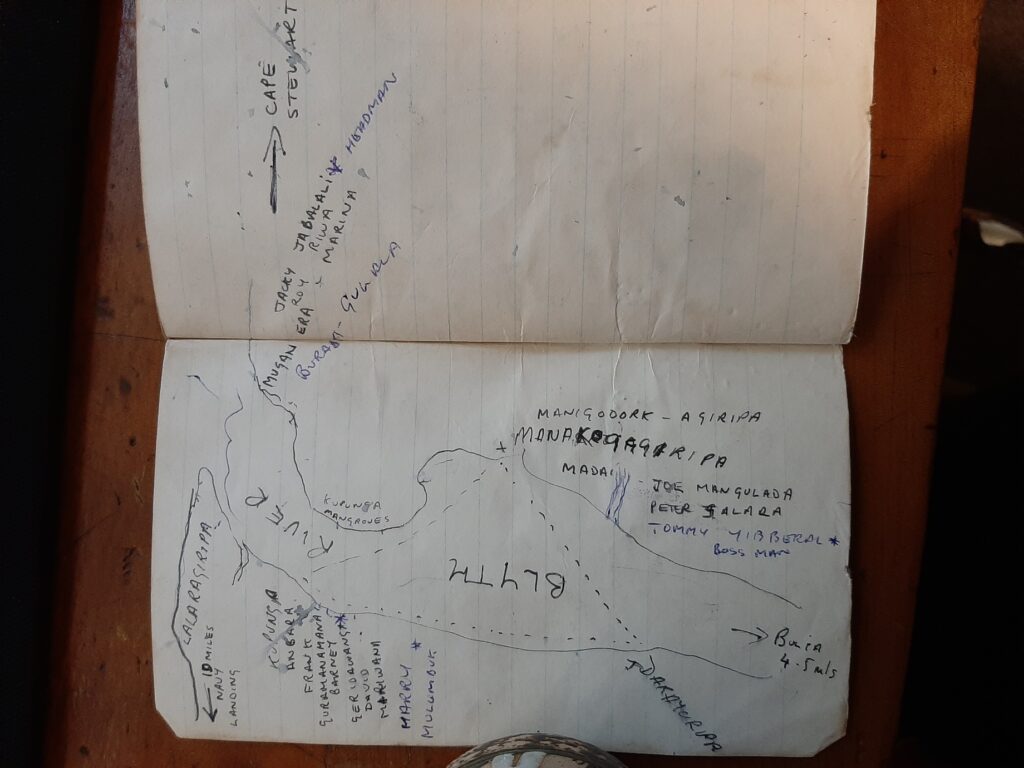
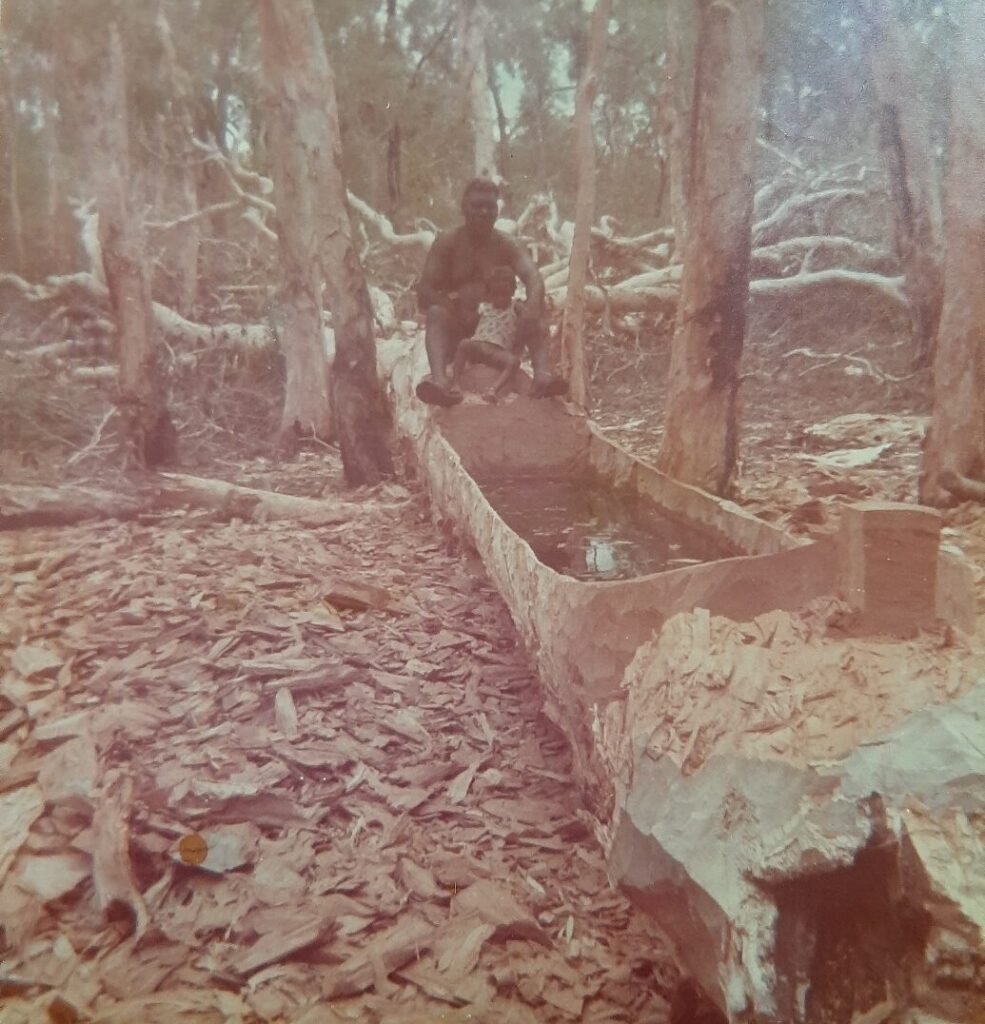 I wondered whether the crocodile shooting/skin trade had ever been operational in these parts of Arnhem Land, and if so, had the only recently banned practice (outlawed in 1971) meant that the animals were still wary of humanity? Or was the co-existence more to do with a long, traditional understanding of each other’s’ needs?
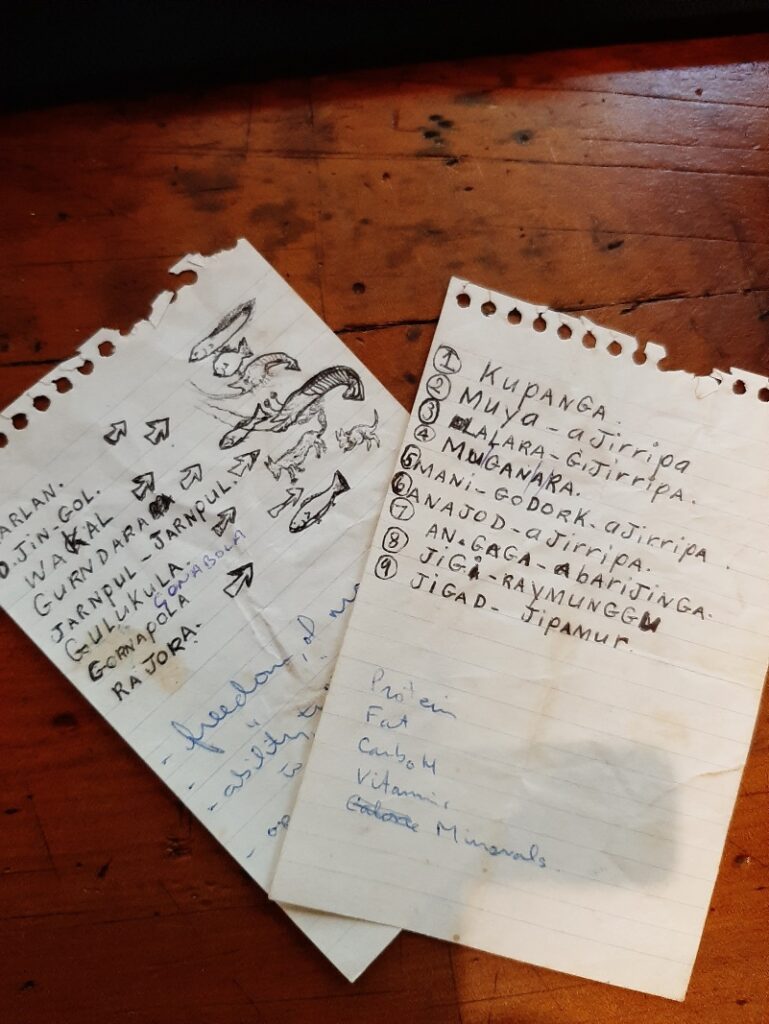 At Dusk, David appeared with a haul of small whistle duck – Blanamirika, maybe twenty-five or so and left two with me. I had plucked, singed, and commenced to cook them by the time he returned from distributing the birds.