
This is Dungbon country, about 80 kilometres south of Maningrida, Central Arnhem land. I am sitting with my ngadjadj. You call him my mother’s brother, my uncle. We are on a ledge; high and shaded, a commanding position with the soft early morning light casting deep shadows across the valley below. Over the past few weeks, we have been here often, always early, surrounded by the detritus of a thousand generations of stone tool makers. This quarry, a resource that underpins so much of our lives, will one day be my responsibility, but for the moment, it’s my classroom. Lessons here will ensure my abilities as a hunter, as a provider.
Bangardi is teaching me the essential skills of knapping, making ‘gadarda’, or spearheads, scrappers and knives from the finely-grained orange chert found across our country. I sense some frustrations at this morning’s efforts. “Balang, not like that. You’ve got to keep your thumbs and fingers clear, bring your hammer down confidently, sharply across the top, flat surface.”
I am flaking chips, but they are small: sharp but useless as spearheads. Bangardi took the paperbark-wrapped hammer from my hand and executes a short, sharp blow that flakes a long sliver of stone, jagged, but razor sharp!
He admits that his knapping was not always so precise; his own ngadjadi spent months with him on this same ledge, honing his skills, teaching him to find the right block of stone, one with a receding underside that would flake satisfactorily. He relates being taught how to select the right hammer from the creek below, refining his posture to deliver the strike, and about the necessary songs that will ensure satisfactory protocols are observed.
Uncle also explains why the hammer needs the paperbark wrapping. He describes how the bark helps distribute the blow evenly, but also how it deadens the echoes from within the stone. Mimih spirits live in the caves and nearby rocks. It is important not to disturb them.
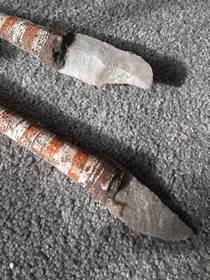 Before the sun sends the animals back into their shady daytime refuges, he picks up two spears, and his woomera, and we leave the ledge. This morning’s knapping lessons are over; another class is about to begin. “So don’t forget, Balang. Always look for the stone with an overhang. Practise getting it right, it will ensure success!”
We quietly follow the creek upstream. A mob of wallabies graze on the dewy grass tufts, and with a practised arm, Bangardi raises and dispatches his spear with deadly accuracy. One of the animals falls, twitching momentarily, and a quick blow to its head finishes the hunt.
The long sinews are drawn from the animal’s hind legs, coiled and placed into his dilly bag looped off his shoulder. I know he will use the cords, fixed with spinifex resin, to adhere a spearhead to a long, straight haft, if I ever manage to produce a suitable flake!
The deep blue, early morning sky is washing out as we gather dry grass, light it and singe off the animal’s fur. We snack on its sweetmeats before making our way back home.